ASEAN’s environmental rights declaration: historic words, courageous action needed

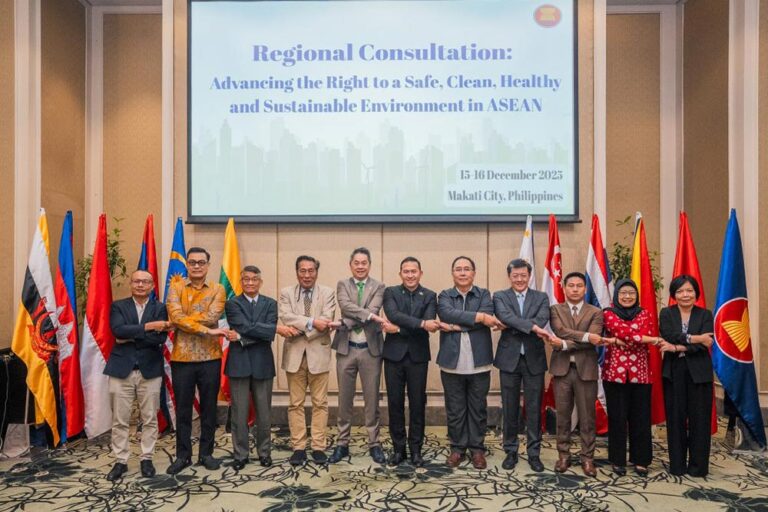
Green Peace | Greenpeace Southeast Asia (GPSEA) welcomed the adoption of the ASEAN Declaration on the Right to a Safe, Clean, Healthy and Sustainable Environment, calling it a long-overdue step that recognises environmental protection as a human right across the region. GPSEA urged ASEAN to show real courage to turn recognition into action and make environmental rights a lived reality.

东盟通过“双里程碑”宣言 云大舜:聚焦环境与发展权

东方Online | 在马来西亚轮值东盟主席期间,成员国通过两项历史性宣言,申明和平、人权与可持续发展的承诺。相关东盟宣言分别是《促进发展权利与和平权利,以实现包容和可持续发展》,以及《享有安全、清洁、健康与可持续环境的权利》。

AICHR urges ASEAN to embed human rights in all future agreements

Free Malaysia Today | AICHR Chair Edmund Bon said the right to development, as enshrined in the ASEAN Human Rights Declaration, must be viewed as both an individual and collective right. Genuine development is inseparable from human rights, and ASEAN member states should embed robust human rights safeguards into all future cooperation and trade frameworks.

Civil society urges ASEAN & EU to end modern slavery at SEA

The Southeast Asia Desk | The Working Group on Solidarity for Migrant Fishers called for decisive action to end modern slavery and protect migrant fishers’ rights in Southeast Asia’s fishing industry. The coalition of 20 civil society organisations from eight countries warned that forced labour, trafficking, and abuse remain widespread in the region’s billion-dollar fisheries sector.

Joint press release: The 6th ASEAN-EU Policy Dialogue on Human Rights, 15 October 2025 and Side Event: ASEAN-EU Dialogue on Intensifying Actions and Overcoming Barriers in Implementing Business and Human Rights and Environment in ASEAN and EU, 16-17 October 2025, Kuala Lumpur and Pahang, Malaysia

AICHR | The 6th ASEAN-EU Policy Dialogue on Human Rights, co-chaired by AICHR Chair Edmund Bon, marked another milestone in strengthening interregional cooperation on human rights, the rule of law, good governance and democratic values for both regions.

EU lauds Malaysia’s ASEAN role, human rights advocacy

Bernama | The European Union (EU) commended Malaysia’s ASEAN 2025 chairmanship, describing it as tremendous and impressive while also expressing hope to strengthen cooperation with the region by enhancing human rights values within future economic and trade agreements.

Community: FPIC must be written into law to make a real difference

The Edge Malaysia | Edmund Bon explained that unless the principle of “free, prior and informed consent” (FPIC) is actually expressly stated in Malaysian law or the Constitution, indigenous peoples will have a very difficult time implementing that principle against the government. Without FPIC, land conflicts are likely to intensify.

ASEAN better at confronting difficult human rights issues, says AICHR chair

Free Malaysia Today | AICHR Chair Edmund Bon said human rights issues were far more difficult to discuss in the past, with certain member states opposed to making the commission’s findings publicly available. There has been significant improvement from this cautious approach, as the countries have grown more confident in addressing such issues over the past decade.

ASEAN’s environmental rights declaration: historic words, courageous action needed

Green Peace | Greenpeace Southeast Asia (GPSEA) welcomed the adoption of the ASEAN Declaration on the Right to a Safe, Clean, Healthy and Sustainable Environment, calling it a long-overdue step that recognises environmental protection as a human right across the region. GPSEA urged ASEAN to show real courage to turn recognition into action and make environmental rights a lived reality.

东盟通过“双里程碑”宣言 云大舜:聚焦环境与发展权

东方Online | 在马来西亚轮值东盟主席期间,成员国通过两项历史性宣言,申明和平、人权与可持续发展的承诺。相关东盟宣言分别是《促进发展权利与和平权利,以实现包容和可持续发展》,以及《享有安全、清洁、健康与可持续环境的权利》。

AICHR urges ASEAN to embed human rights in all future agreements

Free Malaysia Today | AICHR Chair Edmund Bon said the right to development, as enshrined in the ASEAN Human Rights Declaration, must be viewed as both an individual and collective right. Genuine development is inseparable from human rights, and ASEAN member states should embed robust human rights safeguards into all future cooperation and trade frameworks.

Civil society urges ASEAN & EU to end modern slavery at SEA

The Southeast Asia Desk | The Working Group on Solidarity for Migrant Fishers called for decisive action to end modern slavery and protect migrant fishers’ rights in Southeast Asia’s fishing industry. The coalition of 20 civil society organisations from eight countries warned that forced labour, trafficking, and abuse remain widespread in the region’s billion-dollar fisheries sector.

Joint press release: The 6th ASEAN-EU Policy Dialogue on Human Rights, 15 October 2025 and Side Event: ASEAN-EU Dialogue on Intensifying Actions and Overcoming Barriers in Implementing Business and Human Rights and Environment in ASEAN and EU, 16-17 October 2025, Kuala Lumpur and Pahang, Malaysia

AICHR | The 6th ASEAN-EU Policy Dialogue on Human Rights, co-chaired by AICHR Chair Edmund Bon, marked another milestone in strengthening interregional cooperation on human rights, the rule of law, good governance and democratic values for both regions.

EU lauds Malaysia’s ASEAN role, human rights advocacy

Bernama | The European Union (EU) commended Malaysia’s ASEAN 2025 chairmanship, describing it as tremendous and impressive while also expressing hope to strengthen cooperation with the region by enhancing human rights values within future economic and trade agreements.

Community: FPIC must be written into law to make a real difference

The Edge Malaysia | Edmund Bon explained that unless the principle of “free, prior and informed consent” (FPIC) is actually expressly stated in Malaysian law or the Constitution, indigenous peoples will have a very difficult time implementing that principle against the government. Without FPIC, land conflicts are likely to intensify.

ASEAN better at confronting difficult human rights issues, says AICHR chair

Free Malaysia Today | AICHR Chair Edmund Bon said human rights issues were far more difficult to discuss in the past, with certain member states opposed to making the commission’s findings publicly available. There has been significant improvement from this cautious approach, as the countries have grown more confident in addressing such issues over the past decade.