
The role of national and regional human rights institutions in achieving the ends of the Declaration
Excellencies, distinguished guests, ladies and gentlemen.
Although I wish I could have delivered my intervention in person, I thank you for allowing me to say a few words through this recording for this 18th session of the United Nations Expert Mechanism on the Rights of Indigenous Peoples.
The adoption of the United Nations Declaration on the Rights of Indigenous Peoples (UNDRIP) in 2007 was historic. It affirmed the dignity, rights and agency of indigenous peoples globally. All ten member states of the Association of Southeast Asian Nations (ASEAN) voted in favour. However, nearly two decades later, there are immense challenges in the realisation of the Declaration.
Regional human rights institutions, such as the ASEAN Intergovernmental Commission on Human Rights (AICHR), have an important role to play in advancing the UNDRIP. We are situated between the United Nations and national governments such that we can bridge global norms and domestic realities. We can help localise, vernacularise and operationalise international instruments, such as the UNDRIP, while reinforcing accountability and coherence across the region.
2025 is an important year not only for Malaysia as the Chair of ASEAN, but for ASEAN as a regional bloc. In Kuala Lumpur recently, ASEAN adopted a new vision, ASEAN 2045: Our Shared Future. It is a forward-looking blueprint that charts the course of our region for 20 years. Together with ASEAN’s Strategic Plans, it will guide the work of ASEAN institutions, including AICHR, to build a more resilient, inclusive, innovative, dynamic, and people-centred ASEAN.
The participation of groups in vulnerable and marginalised situations is also underscored to ensure their full potential and to improve the quality of life for them ensuring shared prosperity leaving no one behind.
Malaysia’s ASEAN theme, “Inclusivity and Sustainability,” reflects this commitment aligned with our MADANI concept which envisions a compassionate, inclusive, sustainable, and prosperous society.
Inclusivity is not just a principle. It is also a test of our current systems. Our laws. Our governance.
It demands that we centre the voices made vulnerable and marginalised: women, children, persons with disabilities, indigenous peoples, Orang Asli, Orang Asal, migrant workers, refugees, asylum-seekers, stateless persons, ethnic, religious, linguistic, and gender minorities, and human rights and environmental rights defenders. They have the right to participate, contribute, and benefit equitably from the political, social, cultural, and economic developments within ASEAN. It is when we design systems and processes that truly serve the most vulnerable that we build a society that works for all.
Sustainability, in turn, is rooted in the respect for human rights and environmental stewardship. It cannot just be a buzzword in today’s time and age. Without respecting and protecting the rights of people and the planet, there can be no fair, just or lasting development.
According to the World Health Organization (WHO), it is estimated that over 216 million indigenous peoples call the Southeast Asia land surface home. The communities often face intersecting challenges, from land dispossession and displacement to limited access to essential services, representation, remedies, and justice. Further and unfortunately, many indigenous communities are not recognised as such by their governments. Yet, they hold traditional and indigenous knowledge, and culture that are important to us. Lessons from indigenous ecological stewardship is also badly needed by our region.
The UNDRIP is not merely aspirational. It is increasingly being used as a guiding instrument to understand State obligations and as a baseline to develop policies and frameworks concerning the promotion and protection of indigenous peoples’ rights. Further, it supports their right to participate in decision-making on matters that affect their lives, lands, culture, and resources. Meaningful participation needs to go far beyond mere consultation. It requires representation, empowerment, informed consent, and equity in outcomes.
Since its establishment in 2009, AICHR has served as ASEAN’s overarching human rights mechanism. Its convening power has organised more than 155 activities across 40 thematic areas bringing representatives of governments, civil society, national human rights institutions, the private sector, and indigenous communities, for dialogue.
In December 2024, AICHR hosted its “Workshop on Best Practices in Promoting Indigenous and Traditional Knowledge in Responding and Adapting to the Impact of Climate Change”. Held in Manila, the Philippines, participants examined the impact of the global climate emergency on indigenous groups and traditional communities, highlighting how their unique perspectives can help address this challenge directly. The sharing of experiences and good practices particularly by the indigenous from other climate-vulnerable areas such as the Pacific Island states was extremely valuable to ASEAN.
This year, AICHR is looking forward to the much-anticipated adoption of the proposed ASEAN Declaration on the Right to a Safe, Clean, Healthy and Sustainable Environment. This landmark initiative recognises the interconnectedness of human rights and the environment, including the traditional and indigenous knowledge and techniques that sustain climate resilience in communities.
Critically, this Declaration seeks to continue ASEAN’s commitment in protecting the rights of groups in vulnerable and marginalised situations including the indigenous peoples.
In closing, we must greatly sustain and accelerate the enhancement of our advocacy on the UNDRIP with policymakers and non-State actors to take more meaningful, inclusive and rights-based action to protect the rights of indigenous peoples globally.
Thank you.
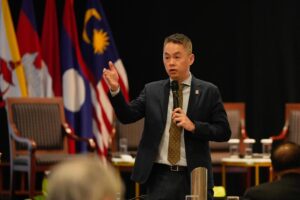
A video recording of Edmund Bon’s remarks was screened on 15 July 2025 at the 18th session of the UN Expert Mechanism on the Rights of Indigenous Peoples that took place from 14 to 18 July 2025 in Geneva, Switzerland. The video recording of the remarks is available here; and the video recording of the 3rd meeting of the 18th session is available here, where the remarks begin at 43:15.