
Excellency Chair Olga Marta Sauma Uribe, Permanent Representative of Costa Rica to the United Nations in Vienna,
Excellency Tsengeg Mijiddorj, Permanent Representative of Mongolia to the United Nations in Vienna,
Excellency Aqeel Malik, Minister of State for Law and Justice of Pakistan,
My fellow panellists: Dr Mai Sato, United Nations Special Rapporteur on Iran, and Ms Giada Girelli, Harm Reduction International,
Distinguished delegates,
Ladies and gentlemen,
Thank you for inviting me once again to participate in this important discussion. When I first spoke here in 2024, I focused my intervention on Malaysia’s national experience. My country went from carrying out its last execution in 2017 to establishing an official moratorium on executions in 2018, and eventually abolishing the mandatory death penalty and imprisonment for natural life, as well as repealing the death penalty completely for seven offences, in 2023. The resentencing process that ensued saw the number of people under sentence of death lower from over 1,200 before the reforms to approximately 50 confirmed death sentences afterwards, in just over a year.
I cannot understate the importance of these achievements. Yet, it has been a journey not free from obstacles, all largely centred around the perception of the death penalty as a just and effective punishment. A key factor in driving this positive change has been studying and informing key stakeholders and the public on the realities of the death penalty, which, at times, has been unfairly applied, is disproportionate, and has affected those at the margins of our society, from most disadvantaged backgrounds. A punishment that is not only in contravention of international human rights law and standards, but which has also failed to completely deliver on its promise of safety.
The death penalty is irreversible. It cannot be undone, unlike any other punishment. If the justice system makes a mistake, be it due to faulty evidence, mistaken identity, inadequate legal representation or unreliable witnesses, that error becomes permanent, and it comes to say that no justice system is perfect. Every system is capable of mistakes.
We also need to acknowledge that the death penalty often accentuates the broader social inequalities. Around the world, those who face capital punishment tend to be the poor or marginalised. They are also more likely to have limited access to effective legal representation. These essentially reflect inequalities that already exist within society.
Malaysia’s resentencing process has now concluded. The government is in the process of reviewing the death penalty as a form of punishment in our criminal justice system. Hopefully, the next step will be a complete abolition of the penalty.
As we progressively shift away from this punishment, other critical issues have come to the fore. These include the urgent need to support those transitioning back into society after decades on death row, the impact of criminal records on employment opportunities, and the effective implementation of comprehensive education and rehabilitation programmes in our facilities. The need to focus resources on tackling the root causes of crime and recidivism has become even more urgent.
When talking specifically about the death penalty for drug-related offences, it has been impossible to divorce this conversation from the need to re-look some of the underlying assumptions of our responses to the drug trade. Some ASEAN countries have begun to challenge the highly punitive and stigmatising approach of law enforcement while advocating for a move towards harm reduction and health responses. Legal reforms on this issue have been under active discussion in the past couple of years.
Malaysia has not been alone in advancing this journey in Southeast Asia. Viet Nam and Thailand have adopted reforms and initiated measures to achieve more proportionate and equitable responses while expanding access to health and social services. Commutations for drug-related offences have also been seen in Indonesia and Singapore. At the ASEAN Intergovernmental Commission on Human Rights (AICHR), these key human rights issues, among others, are regularly deliberated on.
While any progress is encouraging, there is no hiding that the continued retention of the death penalty in our region hinders our human rights progress. In my view, drug-related offences do not meet the threshold of the “most serious crimes” under international law. Complaints about mandatory death sentences, unfair trials, restricted access to legal counsel from arrest, and the lack of mental health assessments are some of the cases we receive. These are not merely legal issues; they are matters of justice, dignity, and humanity.
As much as regional cooperation has been a key feature of law enforcement, it is critical that we reflect on a changed approach within the region. It is in this context that, as Malaysia’s representative to AICHR chairing the Commission last year, I made it a point to initiate a landmark programme to address the intersection of drug policies with human rights and health, focusing on the need for a more human rights-based approach to drug policy. Representatives from ASEAN Senior Officials on Drug Matters (ASOD), among others, attended.
The training was introduced at a critical time, as the ASEAN Work Plan on Securing Communities Against Illicit Drugs, which ran from 2016, came to an end in 2025, and a new one is in the pipeline. The discussions focused on integrating human rights into the traditional “zero-tolerance” approach adopted in ASEAN through two key principles: first, embedding the “do no harm” principle in law enforcement policies; and second, re-centring health as a right to be protected, rather than a service to be delivered. We are now considering, as AICHR, our common position moving forward.
The Commission on Narcotic Drugs (CND), as the principal policymaking body of the United Nations on all matters of international drug control and as the governing body of the United Nations Office on Drugs and Crime (UNODC), enjoys strong support from ASEAN governments, including my own. It is imperative that the United Nations’ commitment to human rights is meaningfully actioned throughout all its work and policies. The ripple effect of those would have no bounds.
Thank you.
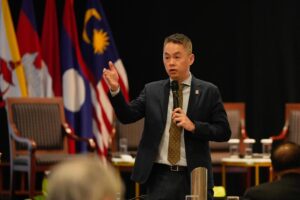
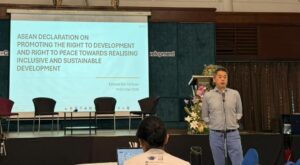
These remarks were delivered by videoconference on 12 March 2026 at the side event of the 69th session of the United Nations Commission on Narcotic Drugs, “From data to national and regional journeys: Renewing commitment to end the death penalty for drug offences”, that took place in Vienna, Austria. Listen to Edmund Bon’s remarks here.