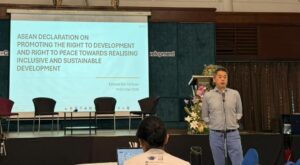

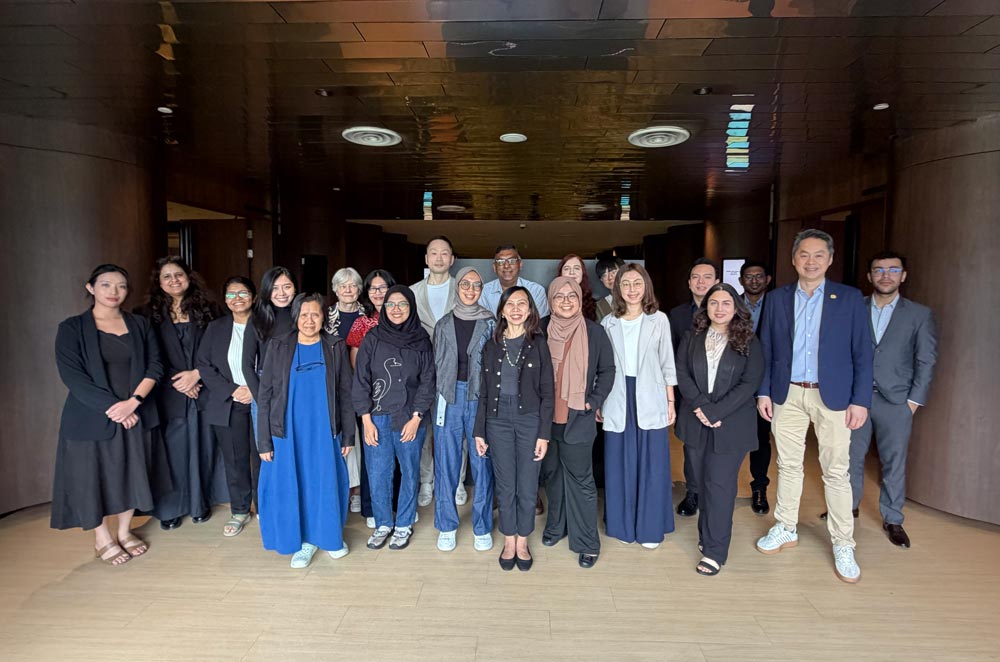
Thank you to the Malaysian Centre for Constitutionalism and Human Rights (MCCHR) and The Rights Practice (TRP) for organising this roundtable and inviting me to speak.
Across Asia, discussions on the death penalty have continued to gain momentum in recent years, with some countries re-examining the role of capital punishment within their legal systems. This did not happen overnight. Being in legal practice and having been involved with civil society and the ASEAN Intergovernmental Commission on Human Rights (AICHR) have reminded me that these developments were the result of years of advocacy, dialogue, research, and, importantly, a deeper look at the realities surrounding the death penalty. And these changes deserve recognition because the path towards reform has never been straightforward.
A close examination shows that the argument that the death penalty has a deterrent effect is weak at best. There may be a correlation, but there is no conclusive evidence of direct causation. Crime rates increase or decrease for numerous reasons. Engagements and research with policymakers and stakeholders, including families of individuals on death row, have also shown how capital punishment has often been applied in ways that are uneven and disproportionate. This is further exacerbated by conditions of social inequality.
Execution of the death penalty cannot be reversed. If an error occurs, it is permanent. And for this reason alone, it demands the highest standards of legal representation and scrutiny. Trial defence counsel play a crucial role in this. They serve as an essential safeguard, ensuring that the prosecution’s case is thoroughly tested and that the rights of the accused are protected at every stage of the process. They form a barrier between an imperfect, if not flawed, process and an irreversible outcome.
Malaysia went from carrying out its last execution in 2017 to establishing an official moratorium on executions in 2018 and eventually abolishing the mandatory death penalty and imprisonment for natural life, as well as repealing the death penalty completely for seven offences, in 2023. The resentencing process that ensued saw the number of people under sentence of death lower from over 1200 before the reforms to approximately 50 confirmed death sentences afterwards, in just over a year.
I cannot understate the importance of these achievements. Yet, it has been a journey not free from obstacles, all largely centred around the perception of the death penalty as a just and effective punishment. A key factor in driving this positive change has been studying and informing key stakeholders and the public on the realities of the death penalty, which, at times, has been unfairly applied, is disproportionate, and has affected those at the margins of our society, from the most disadvantaged backgrounds. A punishment that is not only in contravention of international human rights law and standards, but which has also failed to completely deliver on its promise of safety.
Despite positive developments around the world, even in Malaysia, we must continue to ask ourselves this question: Should the state retain the power to impose irreversible punishments in a system that we know can make mistakes? Societies evolve, and many countries have concluded that the risks associated with capital punishment outweigh its perceived benefits. Regardless of where each country stands, effective defence will continue to play an important role in ensuring fairness and justice within the legal process and is therefore not simply a procedural necessity.
Malaysia’s resentencing process has now concluded. The Government is in the process of reviewing the death penalty as a form of punishment in our criminal justice system. Hopefully, the next step will be a complete abolition of the penalty.
In this context, the Regional Guidelines for Lawyers Representing Individuals Facing the Death Penalty and Execution in Asia (KL Guidelines) are important. The process and the engagement leading up to the drafting — and the implementation phase to socialise the Guidelines — have been as critical as the instrument itself. Being here today with you bears witness to the integrity of that process.
The KL Guidelines are a gesture of solidarity — they acknowledge the immense burden placed on so many lawyers across Asia and provide support, often in contexts where remuneration is far from adequate.
They also serve as a mission statement, grounding our work in principles that should always be at the forefront of our legal representation. They ground us in the inherent dignity of our humanity, which does not get lost when we commit a crime. They ask us for our full commitment to a case, from start to clemency, because it is that commitment and familiarity that make us more effective in our advocacy. The Guidelines also challenge us to disrupt systemic injustices, procedural irregularities, and institutional biases that compromise the integrity of capital proceedings — and, I dare say, any legal system, beyond capital crimes.
Stemming from this, the Guidelines make the point that lawyers should engage in advocacy for legal and policy reform. This is critical because systemic changes are sometimes the only relief left, and we are bound by our duties to our clients. It is also the only way to alleviate systemic barriers to equal and effective access to fair justice.
The death penalty is, in many respects, a political choice. It is often a highly politicised form of punishment. We frequently see “tough on crime” advocates use it as a symbol to score political points, with ripple effects on policy and resource allocation — including in areas that may influence the judiciary or decisions on extradition. Abolitionists are unfairly portrayed as being pro–drug trafficker or pro-crime. Public perception surveys and opinion polls are then invoked to legitimise majority support for the death penalty. But such surveys must be treated with caution: their conclusions depend on who is asked, what is asked, and how the questions are framed. The methodology and data, therefore, require close scrutiny. Ultimately, whether to retain or abolish the death penalty is a choice governments make.
From this lens, it becomes impossible to separate our work from the political context, adding to the arbitrariness of the death penalty. The KL Guidelines are quite unique in this respect, as they openly acknowledge that some clients and their cases can become pawns in political narratives and address the need for lawyers to come to the fore in the response.
This is why we are here today. I look forward to hearing from you and brainstorming together on how we can take the implementation and socialisation of the document to the next level and make the most of the disruptive elements that are enshrined in this important weapon.
Thank you.
These remarks were delivered at the “Approaches and challenges to implementation and promotion of the KL Guidelines” panel session on 14 March 2026 in Kuala Lumpur. The KL Guidelines website is here.