
In Southeast Asia, conversations in the Business and Human Rights-Environmental, Social and Governance (BHR-ESG) space focus on encouraging companies to voluntarily adopt sustainability measures and subsequently report on their sustainability initiatives. While some progress has been made, it remains insignificant in the larger scheme of things. Serious violations of labour and environmental rights are still evident, with no signs of improvement.
Some companies eager to do the right thing have begun their BHR-ESG journey, while others remain hesitant. Despite the availability of resources, questions such as “What do we need to do?”, “How do we start?” and “How much is enough?” continue to arise.
Unfortunately, we notice that companies typically respond actively only when faced with criminal or civil cases, reputational damage and negative publicity. By that point, it is too late; victims are already harmed and survivors are affected. Preventive action should have been taken.
Game-changer for corporate accountability
Mandatory due diligence is going to be imposed by the European Union (EU) Corporate Sustainability Due Diligence Directive (CSDDD). There are key features.
1. Identifying and addressing risks: Businesses must identify, prevent and mitigate human rights and environmental risks in their operations and throughout their value and supply chains. Companies must adopt a “risk-based” approach to human rights and environmental due diligence, take measures to implement prevention and corrective action plans, and provide support to their small and medium enterprises’ suppliers. Supplier disengagement is the last resort when all other measures to address the impacts have failed.
2. Businesses affected: The CSDDD applies to large EU and non-EU firms generating significant revenue within the EU market. Companies in developing countries will be affected if their turnover is generated in the EU. EU companies with over 5,000 employees and a global turnover exceeding €1.5 billion (RM7.01 billion) as well as non-EU companies with over €1.5 billion in turnover within the EU will be impacted come 2027.
3. Enforcement: Action may be taken against companies failing to comply. They are liable to fines, damages, compensation (to be paid to victims and survivors) and injunctions. Public statements regarding violations may be issued against the company. Lawsuits can be filed by injured parties through authorised trade unions and non-governmental human rights or environmental organisations.
Corporate Malaysia’s response
For Malaysian businesses, the CSDDD’s trickle-down effect will be slow, except for those driven by their European multinational counterparts to comply immediately.
Unless the Malaysian government imposes mandatory due diligence (which is one of the recommendations being considered for the National Action Plan on Business and Human Rights to be launched in early 2025), most businesses are likely to keep it on the back burner.
For those willing to embrace the challenge, we foresee three positive outcomes from the CSDDD.
1. Greater transparency and accountability: The directive aims to improve transparency and accountability in business operations and supply chains, complementing existing Malaysian due diligence legal requirements that directors are expected to uphold. Directors can defend themselves against personal liability by demonstrating due diligence under Malaysian criminal law. However, presently, Malaysian companies have, by and large, failed to act — mainly through innocent ignorance — on this, resulting in widespread criminal liability exposure for their directors over human and environmental rights concerns.
2. Improved stakeholder and rightsholder engagement: The directive’s application is expected to enhance the effectiveness of engagements with stakeholders and rightsholders necessary for due diligence. Interactions with suppliers must go beyond the merely symbolic (“for show”) as liability can, under the directive, be imposed for failures on the suppliers’ part.
3. Market opportunities and competitive edge: Even though compliance costs will increase, businesses that can better align their operations will gain a larger market share or greater access to the EU compared to those who fail to meet the directive’s demands. Early adopters of sustainable practices should gain a competitive edge, attracting more EU-based buyers and consumers who prioritise responsible and ethical supply chains.
A non-Western approach towards human and environmental rights accountability?
In 2023, the EU stood as Malaysia’s fourth-largest trading partner globally and its third-largest among ASEAN countries. According to data from the European Commission, the EU’s imports from Malaysia were valued at €29.1 billion that year. These figures underline the CSDDD’s anticipated impact and the growing importance of corporate sustainability and responsible business practices, which are no longer optional considerations.
Nevertheless, we are aware of concerns voiced by some that the CSDDD may carry underlying political motivations or a broader “agenda”. Let us be clear: We are not here to defend the EU or explain its actions. Malaysia, like any ASEAN nation, should not be led or dictated to by Western powers or any global superpower. We stand firm on this principle.
The critical question, then, is about Malaysia’s and ASEAN’s leadership. How will Malaysia and ASEAN take charge of addressing the human and environmental rights violations within the region? What viable, effective, equitable and sustainable alternatives have ASEAN governments proposed to protect human rights? The reality is that unless we can show that we are up to the mark, external forces will drive our conduct. It is no use complaining about how others are imposing demands on us when we have no answer in riposte.
The challenge lies in establishing a distinctly non-Western framework for human and environmental rights accountability — one likely rooted in Southeast Asia’s context — while still upholding global human rights standards. Exploring and developing such an approach is a task we are deeply interested in pursuing.
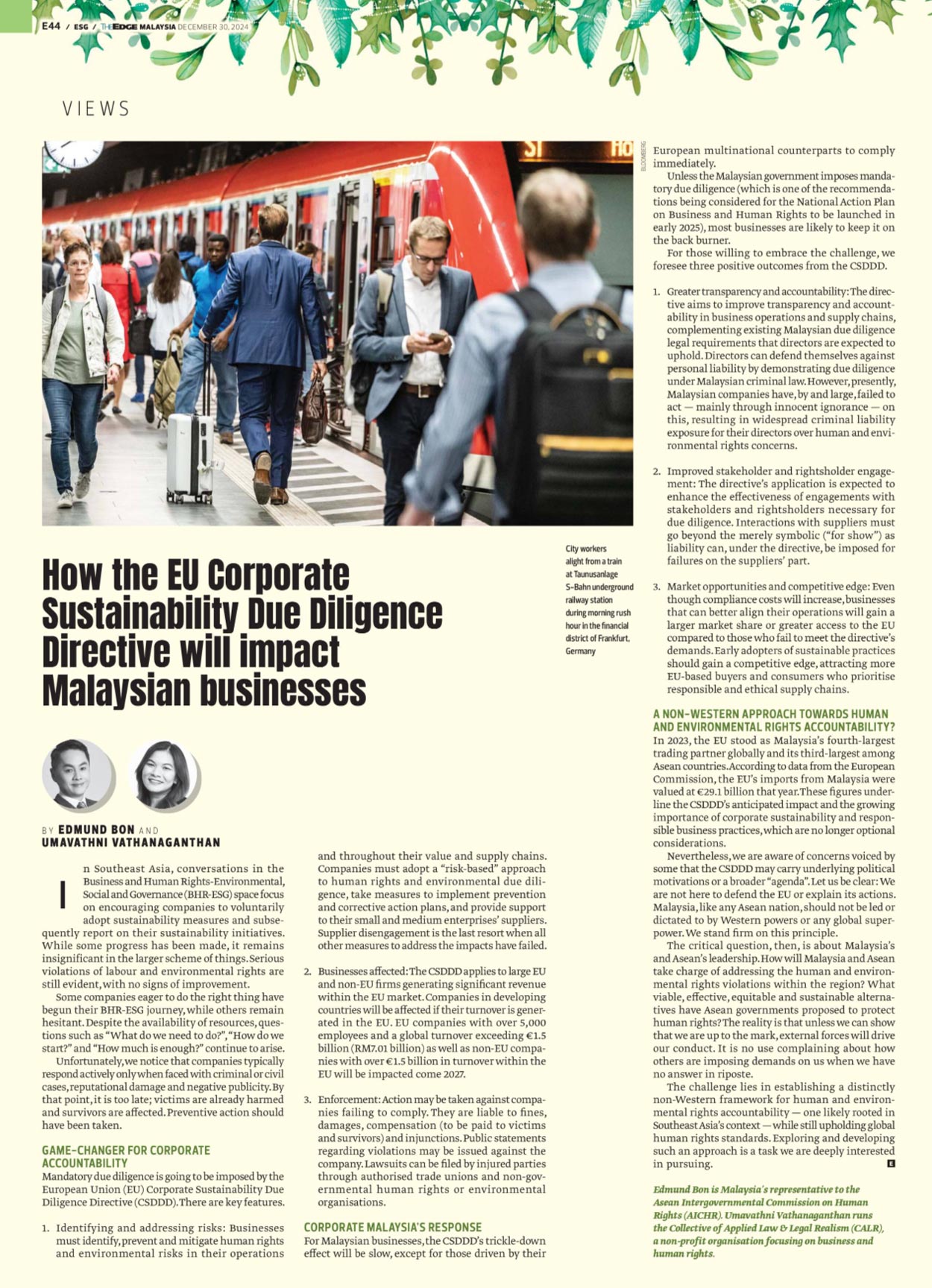
This article was published by The Edge Malaysia Weekly, archived here. Edmund Bon is Malaysia’s representative to the ASEAN Intergovernmental Commission on Human Rights (AICHR). Umavathni Vathanaganthan runs the Collective of Applied Law & Legal Realism (CALR), a non-profit organisation focusing on business and human rights.