
Seventeen years ago today, at the 15th ASEAN Summit in Cha-am Hua Hin, Thailand on 23 October 2009, ASEAN Leaders inaugurated the ASEAN Intergovernmental Commission on Human Rights (AICHR) as ASEAN’s human rights body. ASEAN promised that the Commission would adopt an evolutionary approach to the promotion and protection of human rights. It would be uniquely an ASEAN-led, ASEAN-owned human rights commission.
AICHR’s numerous workshops have recorded persistent feedback from stakeholders calling for protection work to be “balanced” with, or increased relative to, promotion work. On this anniversary, and with emphasis on our protection mandate, I reflect on how AICHR is advancing human rights in the region and the challenges that remain. The views here are my own and do not necessarily represent those of AICHR or its Representatives.
AICHR began with a broad mandate but few working methods. Its early years were taken up by the drafting of the ASEAN Human Rights Declaration (AHRD). How else could AICHR operate if there were no baseline standard agreed? On its adoption in 2012, the Declaration was heavily criticised as falling below international human rights standards.
The Commission then built a framework for its operations (2012) and procedures to engage with civil society (2015), among others. In the meantime, Representatives ran regional programmes on a host of human rights issues to bring them forward for socialisation and discussion. While several difficult human rights cases were brought to the attention of AICHR by Representatives, this was done on an ad hoc basis, and the Commission could not agree to act as a body.
In 2018, I presented, on behalf of Malaysia, the guidelines on a communications mechanism. Apart from the administrative decision for the ASEAN Secretariat to acknowledge receipt of the communications in reply to the sender, the proposal was rejected. A year later, the issue was brought up again. AICHR Representatives agreed that complaints be directed to the Representatives of the countries concerned, for follow-up action at their discretion. The ASEAN Secretariat would record and report at each AICHR meeting the communications received and any follow-up action.
In November 2025, AICHR as a collective body adopted the AICHR Operational Guidelines to External Communications Received, which concretised the Commission’s practice in writing for dissemination. Follow-up remains voluntary but open access to AICHR is available to all. Because many concerns also fall within the expertise of other bodies, referral matters. AICHR is currently exploring protection pathways with the ASEAN Commission on the Promotion and Protection of the Rights of Women and Children (ACWC) for matters affecting women and children, and the South East Asia National Human Rights Institutions Forum (SEANF) for transboundary human rights concerns.
Views differ among Representatives within the Commission on how AICHR should carry out its protection work more proactively and responsively. This debate is healthy. Recently, our dialogues on the issue have moved to practice. I have seen AICHR take a critical view of how the Commission can improve (pages 41–42): to have a “communications management system” (institutionalise a more structured and direct approach to addressing communications and set up frameworks that ensure broad acceptance); “proactive leadership for emerging human rights challenges” (enhance discussion on emerging human rights challenges in the region posed by traditional and non-traditional security threats); and “comprehensive data collection system” (establish a comprehensive and accurate data collection system to monitor and address human rights issues and enable comparative assessments and long-term tracking of progress. This is crucial to improving the accuracy and effectiveness of human rights responses, ensuring better-informed decision-making, and enhancing accountability).
As part of creating conditions in which protection work can be understood, accepted and effective, AICHR has moved to express a common, regional human rights position and approach on a range of threats to human rights in the region, including: transboundary haze pollution (13 October 2026), human rights and peace (21 September 2026), access to remedies and justice (8 August 2026), trafficking in persons (30 July 2026), mainstreaming the gender dimension in business (15 December 2025), strengthening the AHRD (18 November 2025), responsible business and migration (14 November 2025), telecommunications network fraud and online scamming (26 September 2025), and earthquakes in Myanmar and Thailand (2 April 2025). This progressive shift by AICHR is within its wide powers: to “develop common approaches and positions on human rights matters of interest to ASEAN” (paragraph 4.11, Terms of Reference). These outcome documents form a normative basis on which protection work can be done when human rights cases come before the Commission. Without a common position or approach, it would be difficult for Representatives to assess human rights issues in a constructive way.
AICHR has also been providing advisory services and technical assistance on human rights matters to ASEAN sectoral bodies (paragraph 4.7, Terms of Reference). The Commission regularly receives numerous requests to provide feedback on cross-cutting issues affecting human rights, particularly new work plans and proposed positions to be taken by other ASEAN bodies. The practice over the years has been that, given the technicalities and the nature of the requests requiring expertise, AICHR first seeks consensus among Representatives on the proposed submission, failing which each Representative’s submission is provided as a country Representative input only. Many of these inputs call for an approach firmly based on human rights, and they are still contested even within AICHR.
Further, AICHR seeks to achieve significant protective effects through constructive dialogue among Representatives on the regular reports they make at every AICHR meeting. Country updates on recent developments in human rights are routinely made. These reports are voluntary and may be followed up by other Representatives seeking more information and responding to queries. Regional human rights cases and complaints are also brought up for further deliberation. AICHR’s Terms of Reference mandate this protection role: to obtain information from ASEAN Member States on the promotion and protection of human rights (paragraph 4.10). Dialogues in a similar format are held annually through the ASEAN Human Rights Dialogue, with the participation of civil society and national human rights institutions, much like the Universal Periodic Review (UPR) process. AICHR is due to host the eighth iteration of the Dialogue this year.
Every year, AICHR meets the ASEAN Foreign Ministers’ Meeting (AMM) in a closed-door interface where frank discussions on human rights progress and challenges take place. Repeatedly, Representatives have raised selected major human rights crises with the AMM on the record. This has included, for example, the situation in Myanmar and the refugee crisis. Issues once hard to raise or discuss regionally are becoming a normal part of ASEAN cooperation.
For me, communications to AICHR are important for preventing human rights and humanitarian crises and for maintaining peace in the region. AICHR Representatives are responding to real situations on the ground, not imaginary ones. Taken together, the communications serve as an effective early warning mechanism, allowing ASEAN to consider trends and patterns in human rights situations across the region. From 2022 to 15 July 2026, AICHR received more than 110 communications, not including those received before 2022. The volume has risen sharply. More communications now come from individuals, including migrants and members of minority communities, and not only from established organisations.
Following views shared at the recent AICHR workshop on peace and conflict, here is a high-level summary of the communications grouped into six domains. The first five measure the conditions and events that make serious human rights violations more likely. The sixth, “protection”, measures the capacity to respond.
(1) People — Who lives in a place and how groups relate to one another. Risk rises where, for example, groups are excluded, discriminated against or denied citizenship, because they become more vulnerable and their grievances deepen.
The communications received concern gender identity; minority issues; historically targeted groups such as ethnic communities and Indigenous Peoples; immigration and deportations; forced displacement; freedom of religion; racial discrimination; and nationality and statelessness.
(2) Power — Who governs and how authority is exercised. Risk rises where, for example, authority is contested, where courts are not independent, or where people cannot obtain justice.
The communications concern the situation in Myanmar; access to justice; transboundary and armed conflicts; judicial harassment; and freedom of information.
(3) Pressure — Economic and environmental strain. Pressure on land, resources, livelihoods and the environment raises the stakes of competition and can push people into displacement or exploitation.
The communications concern environmental rights; business and human rights; labour rights; housing; unilateral coercive measures; and trafficking in persons.
(4) Precedent — What has already happened. Past atrocities, unresolved grievances and impunity are among the strongest predictors of renewed violations.
The communications concern recurring grievances of historically targeted groups; enforced disappearances; atrocities; and truth, justice and reparation.
(5) Peril — Near-term signs that risk is escalating, such as crackdowns, violence, armed confrontation and restrictions on civic space.
The communications concern human rights defenders; freedom of assembly and association; transboundary and armed conflicts; arbitrary detention; torture; freedom of expression and press freedom; the right to life and personal liberty; enforced disappearances; and immigration deportations.
(6) Protection — What can reduce or absorb risk: institutions, civil society, and regional and international actors being able to respond, even where the other five domains are elevated.
In the communications, protection shows in who has raised matters with AICHR, such as civil society organisations, individuals, diaspora groups, national human rights institutions and the United Nations, and in whether AICHR Representatives have followed up and AICHR has responded as a body. The response is strongest where civil society is active and Representatives reply, and weakest where several risks converge. Follow-up was highest in 2025, and the figures for 2026 are not yet complete.
Where these domains intersect, the risks compound.
Of course, I am acutely aware that communications contain allegations. They are not conclusive and require further assessment. Several AICHR Representatives have sought more information from their domestic agencies and from their counterparts in the Commission, even though AICHR has no express mandate to investigate or enforce. I am also aware that where there are no communications on a particular human rights issue, this silence does not mean the issue does not exist or that there is no risk.
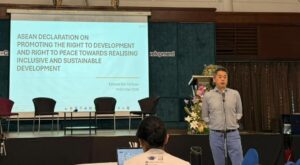
The two declarations adopted at the 47th ASEAN Summit in October 2025, the ASEAN Declaration on the Right to a Safe, Clean, Healthy and Sustainable Environment (ADER) and the ASEAN Declaration on Promoting the Right to Development and the Right to Peace Towards Realising Inclusive and Sustainable Development (ADDP), speak directly to the risks mentioned above. For lasting peace and development, the communications point at least to four needs: including minorities, refugees and asylum-seekers, migrants and stateless persons; resolving grievances; acting on environmental harm and exploitation; and addressing tensions through dialogue before they escalate, with space for people, including human rights defenders, to raise concerns safely. The right to peace supports prevention and dialogue, the right to development supports participation and a fair share in its benefits, and the ADER supports action on harms people already report.
The AICHR communications mechanism is therefore a valuable tool. ASEAN needs to read the domains together, keep them under continuous review, and act early, particularly when the signals converge. I am always ready to provide support and advice as mandated. This complementarity also meets the aspiration in ASEAN 2045: Our Shared Future for our ASEAN mechanisms to be responsive, future-ready, and decisive.
AICHR works within ASEAN’s diplomatic space, where decisions are made in the name of consensus, where non-interference is closely guarded, and progress is often quiet and incremental. We do not pretend that there are no real constraints. But this space also holds real prospects. Because AICHR is an intergovernmental body that ASEAN Member States own, the conversations it carries are conversations ASEAN is having with itself, not ones imposed from outside. This is a uniquely ASEAN path, and it is steadily making human rights a normal part of how the region talks, plans and cooperates.
Efforts by all who have the interests of human rights at heart must continue despite setbacks, despair and disappointment. I remain committed to the ASEAN Charter and the AHRD and will spare no effort to strengthen AICHR from within. Our task is to turn shared commitments into tangible change for the human rights of the peoples of ASEAN. The real test for a regional human rights commission is whether it can change people’s lives for the better.
On this 17th anniversary, I thank all who have supported this work, particularly the former AICHR Representatives, government nominated officials, ASEAN Secretariat officers, human rights experts and civil society representatives who led the way, opened the path and showed us what is possible in pushing for human rights progress within AICHR. I am indebted. I encourage civil society, national human rights institutions and individuals across the region to keep engaging with AICHR, including by bringing communications to the Commission: every voice helps ASEAN see risks early and act on them.
The fight for human rights is not over, and it is one we must carry forward together.
Dated this 23rd day of October 2026