
Colleagues and friends.
On 19 November 2026, the International Court of Justice (ICJ) delivered its judgment on the merits in The Gambia v. Myanmar (11 States Intervening). It is the first time the Court has found a State responsible for committing genocide. My purpose today is not to relitigate the case. It is to share what it could mean for human rights diplomacy in ASEAN.
The scale of the crimes is stark: the Court estimated that about 10,000 Rohingya were killed, and that nearly 400 villages, about 40 per cent of those in three townships of northern Rakhine, were partly or wholly destroyed.
As the Representative of Malaysia to AICHR, I express deep sorrow for the victims and survivors of these grave crimes, and for their families. The ICJ judgment must be respected and implemented.
Importantly, the ICJ now recognises the Rohingya as a distinct ethnic group protected under the Genocide Convention (the Convention on the Prevention and Punishment of the Crime of Genocide). Further, while the majority found that Myanmar had committed genocide, the minority did not deny that the atrocities happened. Rather, it found that genocidal intent was not the only reasonable inference, because other explanations, including forced displacement and collective punishment, remained reasonably available.
The Malaysian Government issued a press statement reaffirming its commitment to upholding international law, including its responsibilities as a State Party to the Genocide Convention. The ICJ’s findings are in line with Malaysia’s position on the protection of all vulnerable peoples including the Rohingya. Malaysia will continue to advocate for a comprehensive and durable resolution to this protracted crisis, including actively engaging all relevant parties to implement concrete measures towards alleviating the plight of the Rohingya sheltered within its territory.
Similarly, it has been reported that the Philippines and Singapore have issued their written statements on the judgment.
The judgment reminds us that the prohibition of genocide binds every State, party to the Convention or not. The principle of non-interference does not apply when an international court with universal jurisdiction has ruled on a crime of this nature. No country should take actions that undermine the judgment.
This affects how we approach human rights in ASEAN. One of our member states has been found to have committed genocide. We need an extremely cautious approach in how we handle refugees and asylum-seekers, and in our engagement with Myanmar.
The Court directed Myanmar to enact legislation giving full effect to the Genocide Convention; investigate, and where warranted prosecute and punish, all persons reasonably suspected of prohibited acts; provide assurances and guarantees of non-repetition; take restitution measures, including the safe, voluntary, and dignified return of the displaced and the reunification of families; compensate the Rohingya group and its members; and report to the Court within two years.
The question before ASEAN is how we can help Myanmar comply with the judgment. ASEAN member states, and relevant ASEAN organs and bodies, can assist Myanmar in implementing the judgment in good faith.
To this end, I would like to share some ideas on what AICHR can do to support implementation of the judgment, and I welcome your feedback. They include:
(a) Engage Myanmar in constructive dialogue on implementation, including to share, exchange, and request information on the measures taken.
(b) Regularly review and follow up on the progress of implementation.
(c) Provide advisory services and technical assistance on legislative and institutional reform. This includes legislation giving effect to the Genocide Convention. It also includes laws and practices on non-discrimination, legal status, documentation, and freedom of movement.
(d) Support capacity building for relevant officials, including those in the security sector, on human rights, atrocity prevention, accountability, cooperation with relevant mechanisms, and the preservation of evidence.
(e) Work with ASEAN mechanisms and international partners to mobilise practical support for the restitution measures. The support would cover, for example, conditions for return, family reunification, the search for missing persons, dignified reburial, and medical and psychosocial rehabilitation.
(f) Host consultations with affected communities, including women and youth, so that the voices of those affected shape these efforts.
(g) Undertake a study on durable solutions and atrocity prevention in the region and promote public awareness of the need to prevent discrimination, hate speech, and incitement to violence.
(h) Follow up on AICHR’s work on forced migration, including by engaging with refugees and asylum-seekers from Myanmar across ASEAN to ensure that the root causes of forced migration are addressed through a holistic, comprehensive, rights-based, and sustainable approach.
Implementation is the best path for Myanmar to rebuild trust with its neighbours and its own people. The return of Rohingya and other Myanmar nationals from our countries should meet the standard the ICJ has set: safe, voluntary, and dignified. Relatedly, return cannot be safe while the conditions that drove people out remain. Citizenship, freedom of movement, and security issues must be addressed.
AICHR can also offer practical support, where Myanmar requests it, for restitution, return areas, and family reunification. This requires us to develop a common approach on the protection of the Rohingya and other displaced persons. A study on durable solutions, with the Rohingya at its centre, would be a start. AICHR can contribute a human rights-based framework on the conditions for safe, voluntary, and dignified return, including citizenship and civil documentation.
Together with colleagues who are equally concerned about the impact of the judgment, I will continue to raise its implementation with Myanmar at AICHR.
Thank you.
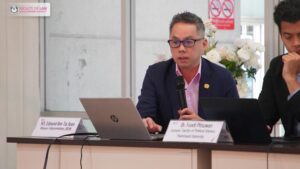
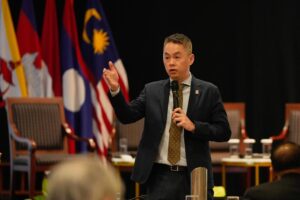
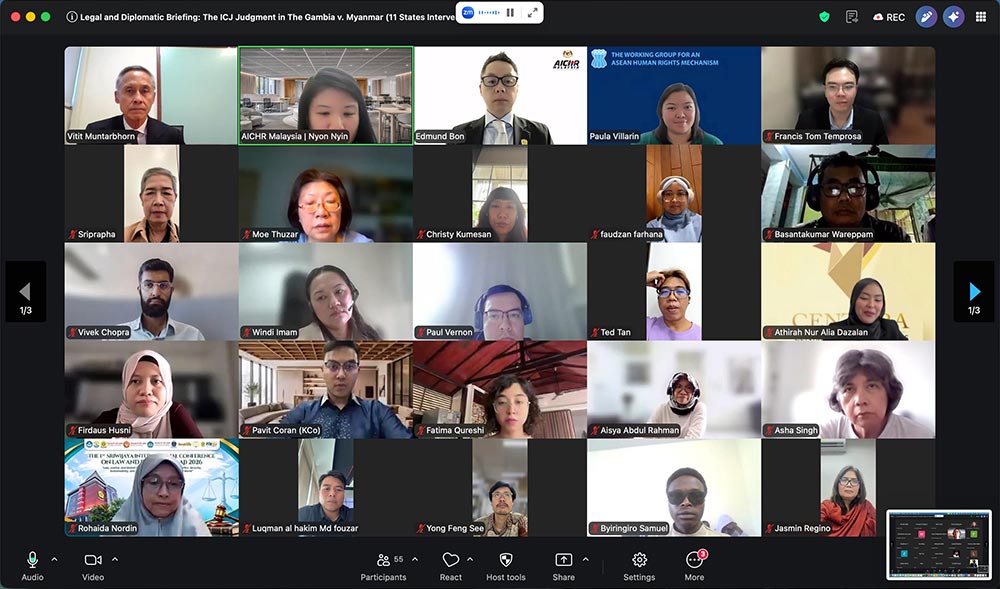
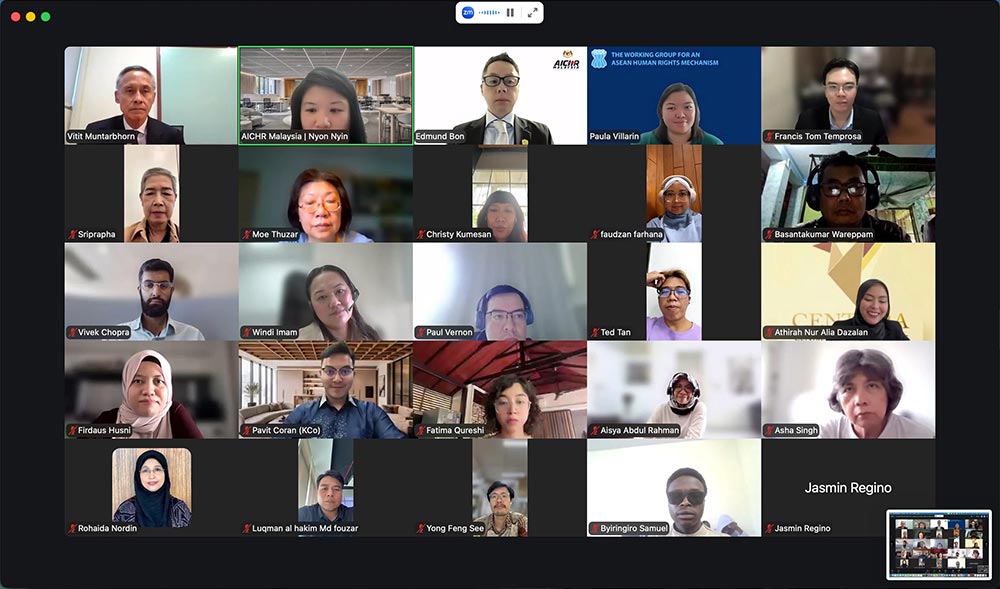
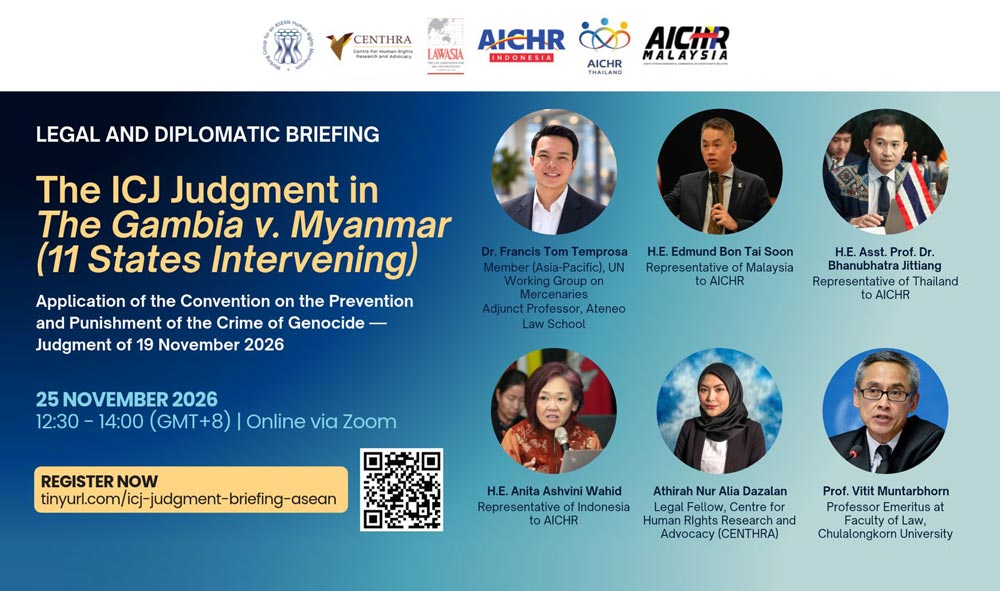
This intervention was delivered at the Legal and Diplomatic Briefing: The ICJ Judgment in The Gambia v. Myanmar (11 States Intervening) — Application of the Convention on the Prevention and Punishment of the Crime of Genocide held on 25 November 2026. The concept note and programme is available here, and the statements by the Philippines and Singapore are archived here and here, respectively.