

Excellency Georgina Ann Hernandez Yang, ASEAN Intergovernmental Commission on Human Rights (AICHR) Chair,
Dato’ Seri Mohd Hishamudin bin Md Yunus, South East Asia National Human Rights Institution Forum (SEANF) Chair,
Distinguished commissioners of national human rights institutions (NHRIs),
Colleagues,
At the outset, allow me to express Malaysia’s appreciation to the Human Rights Commission of Malaysia (SUHAKAM) for its leadership of SEANF this year, and to the ASEAN and SEANF secretariats for the arrangements for this meeting. Malaysia wishes to raise three matters: the role of NHRIs and the communications received by AICHR; the proposed AICHR–SEANF Operational Guidelines on Cooperation Framework Regarding Communications and Referral Modalities establishing the referral mechanism; and the situation in Myanmar.
On the role of NHRIs, AICHR Malaysia wishes to underline two points.
First, NHRIs are the closest link between regional commitments and the lived experience of the peoples of ASEAN. Through complaints handling, monitoring, and inquiries, NHRIs have the power to reach individuals and communities that AICHR seldom engages directly, and you are able to present the voices of victims and survivors. Your independence under the Paris Principles (Principles Relating to the Status of National Human Rights Institutions) must be cherished, and we must continue to support and encourage SEANF members to uphold them.
This meeting is notable in that, for the first time, AICHR has decided to proceed even though one Representative objected to the meeting and withdrew their country’s representation from it. Malaysia wishes to place on record that the fact that we are proceeding is evidence that AICHR, and by extension ASEAN, can proceed, and has proceeded, on the basis of AICHR-minus-X and ASEAN-minus-X. The stated withdrawal cannot be the basis for bringing our continuing engagement to a halt.
Second, many of the human rights concerns now brought before AICHR are transboundary in nature, and no single institution can address them effectively. The communications received by AICHR illustrate this. In November 2025, AICHR adopted the AICHR Operational Guidelines to External Communications Received. From 2022 to 15 July 2026, AICHR received more than 110 communications, not counting those received in earlier years. The number has risen sharply, and a growing share now comes from individuals, including migrants and members of minority communities, and not only from established civil society organisations.
These communications cover a wide range of issues: Indigenous Peoples, ethnic communities, gender identity, freedom of religion, racial discrimination, nationality and statelessness, immigration and deportation, and forced displacement. Others relate to the situation in Myanmar, the Thailand–Cambodia border conflict, armed conflicts more generally, access to justice, judicial harassment, and freedom of information. A further group reflects economic and environmental pressures, among them environmental rights, business and human rights, labour rights, housing rights, and trafficking in persons. Some concern unresolved past violations, such as enforced disappearances, and the rights to truth, justice and reparation. Finally, a number raise serious protection concerns: threats to the right to life, human rights defenders, restrictions on the freedoms of expression, assembly and association, arbitrary detention, and torture.
Malaysia is mindful that communications contain allegations which are not conclusive and require further assessment, and that the absence of communications on an issue does not mean that the issue does not exist. Taken together, however, they are important in showing what our region is facing in terms of human rights. With the help of SEANF, they allow ASEAN to map these issues, identify trends and act before situations escalate, and so serve as an early warning mechanism. Malaysia would like to see an expansive referral mechanism used to this end. We have hosted NHRIs in our AICHR programmes, and you understand the work that we do in the space that we have.
In this regard, I draw attention to three pressing human rights issues and propose them as areas for cooperation with SEANF.
The first is transboundary haze pollution. AICHR has already received complaints on this matter, and the Commission has issued a press release on it. The second is the situation of the Bajau Laut community, particularly their rights to health and education. I note that there is a tripartite Memorandum of Understanding between SUHAKAM, the Indonesia National Commission of Human Rights (Komnas HAM) and the Commission on Human Rights of the Philippines (CHRP). We would welcome a formal briefing on how the issues can be addressed so that AICHR may better understand how we can respond. The third is forced migration and the status of refugees. AICHR has adopted a briefing note on forced migration setting out our collective position and is now looking into the steps needed to follow up on the issue. As you know, Malaysia hosts a large number of refugees from Myanmar. While we need to address the root causes of forced migration, refugees and asylum-seekers within our borders need to be treated in a manner consistent with human rights. Malaysia looks forward to working together with SEANF members to follow up on these cases and protect affected communities.
On the proposed AICHR–SEANF Operational Guidelines on Cooperation Framework Regarding Communications and Referral Modalities (OGCF), the communications are one of the reasons Malaysia attaches importance to them. Because many of the concerns raised with AICHR fall within the expertise of other bodies, referral is essential. Malaysia would like to see a more expansive referral mechanism and echoes the view of the SEANF Chair that the guidelines should be adopted soon. They are one of the outcomes of the AICHR workshops on enhancing ASEAN’s protection mechanisms and of the 5th Interface Meeting.
Finally, the situation in Myanmar remains of serious concern to us all. On 15 November 2026, ASEAN leaders reviewed the implementation of the Five-Point Consensus (5PC). They expressed deep concern over the conflicts and the humanitarian situation in Myanmar and encouraged substantive progress in implementing the 5PC. Recognising the reality that there are still acts of violence taking place, they condemned acts of violence against civilians and public facilities and called on all parties to take concrete steps to stop indiscriminate violence immediately, refrain from any escalation, exercise the utmost restraint, protect all civilians and civilian infrastructure, and create conditions conducive to the delivery of humanitarian assistance and to an inclusive national political dialogue. Each of these concerns engages fundamental human rights.
I propose that AICHR and SEANF keep the situation in Myanmar under joint review, and that the OGCF, once adopted, serve as one means of doing so. When circumstances permit and where it is appropriate, Malaysia would welcome renewed engagement also with a Myanmar National Human Rights Commission (MNHRC) that operates in accordance with the Paris Principles.
Thank you.
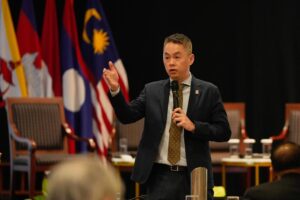
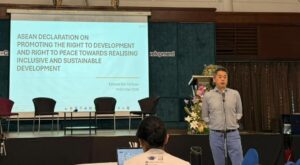
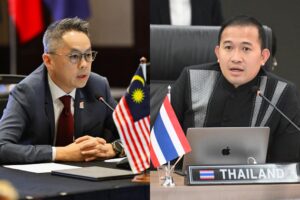
This intervention was delivered via videoconference at the 6th Interface Meeting between the ASEAN Intergovernmental Commission on Human Rights (AICHR) and the South East Asia National Human Rights Institution Forum (SEANF) on 17 November 2026.