
Distinguished guests, ladies and gentlemen.
I thank the organisers for inviting me to speak today. I begin by acknowledging that the conversation on environmental rights in Southeast Asia is not new. However, the urgency has never been greater. What was once a conversation has now become an existential crisis.
Across the region, indigenous communities are losing their homes to relentless deforestation.
Industrial pollution poisons our waters and air, infringing upon the fundamental rights to life, health, and clean water.
Unpredictable and extreme weather events are displacing families, forcing migration, and shattering communities.
Land reclamation is threatening marine biodiversity and disrupting the livelihoods of countless fishermen.
These are the harsh realities that many of us, sitting in the comfort of our offices and homes, may never personally witness. These are the headlines we read but often fail to fully grasp. These are the issues that remain unresolved, affecting the lives of millions.
In a world where climate change and environmental degradation are fast becoming an existential threat, we must understand that the fight for environmental justice is inseparable from the fight for human rights. From the examples we have heard today, environmental rights form the foundation of so many other human rights — whether procedural or substantive — such as the right to life, health, clean water, and food. The recognition of a clean, healthy, and sustainable environment as a human right highlights this connection — it is inalienable, interdependent, interrelated, and indivisible.
The Sustainable Development Goals (SDGs) provide us with a roadmap to address the challenges we are facing and create a better future for all. SDG 3, for example, aims to ensure healthy lives and promote well-being, while SDG 5 seeks gender equality and the empowerment of all women and girls. The intersection between these two goals is undeniable.
Women, as primary caregivers and resource managers, are uniquely positioned to influence change, yet they are often disproportionately affected by environmental crises. Despite their critical role, women remain under-represented in decision-making processes, particularly in environmental ministries.
Women who are environmental human rights defenders are at the forefront of the fight — challenging harmful practices, defending their communities, and advocating for sustainable resource management. But their work often comes at a steep price.
Across the region, these women face arbitrary arrests, threats of violence, legal persecution, and social ostracism. The lack of gender-disaggregated data only obscures the unique challenges they face. With less than five years remaining to achieve the 2030 SDGs agenda, it is crucial that we continue investing in gender equality and gender mainstreaming to ensure inclusive growth and sustainable development across the region.
This year, Malaysia’s ASEAN chairmanship theme is “Inclusivity and Sustainability”. Let me emphasise the point. Inclusivity is not just a goal — it is a call to action. It is a demand for us to listen to and act for those who are made vulnerable and marginalised. They include women, children, persons with disabilities, indigenous peoples, Orang Asli, Orang Asal, migrant workers, refugees, asylum-seekers, stateless persons, ethnic, religious, linguistic, and gender minorities, and human rights and environmental rights defenders. We must design processes that work for those at the greatest disadvantage, because when they succeed, we know we are advancing human rights for all.
At the heart of sustainability is the respect for both human and environmental rights. We must ensure that the development we pursue today does not compromise the dignity, rights, and needs of future generations.
As ASEAN’s human rights charter-body, the ASEAN Intergovernmental Commission on Human Rights (AICHR) plays a pivotal role to strengthen ASEAN commitments on human rights and ensure that the aspirations of ASEAN are fully realised.
In this vein, Malaysia is advocating for the adoption of two declarations this year. One is the proposed ASEAN Declaration on the Right to a Safe, Clean, Healthy, and Sustainable Environment. I am optimistic that the work put into this declaration, which has been two years in the making, will soon bear fruit. As we move forward, I hope that the advocacy from rightsholders and stakeholders remains strong, pushing policymakers and decision-makers to act and make the necessary changes.
The second declaration is linked to the upcoming ASEAN Community Vision 2045. At the heart of this vision lies a collective ambition: to build a region that is not only developed but also inclusive and equitable, where everyone living in Southeast Asia has access to opportunities that enable them to thrive.
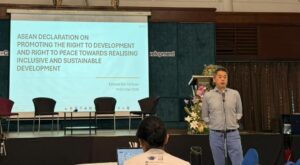
To achieve this vision, we must ensure that our commitment to human rights, sustainable development, and peace remains unwavering. Malaysia’s proposed ASEAN Declaration Promoting Peace, Inclusive Growth, Sustainable Development and the Right to Development will complement the new ASEAN Community Vision 2045 and other key regional initiatives, including the new framework for complementarities between the 2045 Vision and the SDGs due to be adopted this year. This Declaration is a vital step in reinforcing ASEAN’s pledge to achieve sustainable and inclusive growth.
Let me outline why the Declaration is so crucial for ASEAN’s future.
First, it will advance the SDGs. This Declaration will bolster ASEAN’s commitment to the SDGs, particularly those goals that require our immediate attention and greater support, such as promoting peace, building strong institutions, and advancing social, economic, and environmental sustainability across the region.
Second, it will drive an ASEAN-led and ASEAN-owned approach. By adopting this Declaration, AICHR can shape a development model that is uniquely ASEAN. It will ensure that ASEAN’s path to growth and peace is determined by us, on our terms, and not imposed by external forces. This Declaration places ASEAN firmly in the driver’s seat of its own development agenda.
Third, it will mainstream inclusive growth. The Declaration will empower AICHR to integrate inclusive growth and sustainable development into ASEAN’s human rights framework. It aligns directly with the ASEAN Human Rights Declaration (AHRD) and the Phnom Penh Statement on the Adoption of the AHRD 2012, ensuring that the right to economic, social, cultural, and political development as outlined in Articles 35 to 38, are fully realised for every person in ASEAN.
Fourth, it will strengthen cross-pillar collaboration. This Declaration provides a robust foundation for ASEAN sectoral bodies across all three pillars — political, economic, and socio-cultural — to coordinate their efforts, ensuring that human rights, development, and peace are embedded into ASEAN’s broader agenda. A more integrated, collaborative approach will allow us to address the interconnected challenges we face more effectively.
Finally, it will position ASEAN as a global leader. By adopting this Declaration, ASEAN and AICHR will be recognised as champions of inclusive growth and sustainable development, setting a precedent not only for the region but for the world. ASEAN will show that it is not just a passive participant in global development but a leader that is determined to create a better future for all.
In conclusion, by taking the lead on these two declarations, AICHR will drive a transformative shift in ASEAN — turning our commitments into tangible actions and our shared aspirations into lasting reality. It is a call for a future where sustainability, human rights, and development go hand in hand, and where every ASEAN person can thrive in a region that is truly resilient, innovative, and people-centred.
Ultimately, when we protect human rights and our environment, we are securing the future for generations to come. And when we accelerate our actions, we accelerate justice.
Thank you.
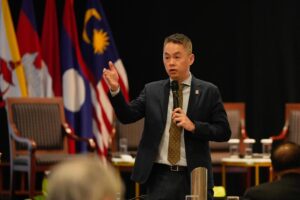
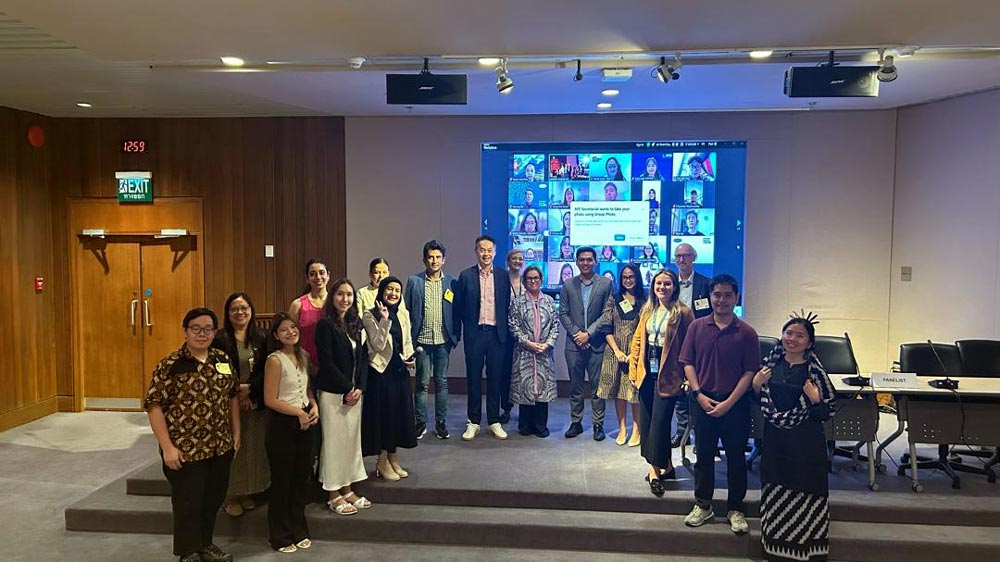
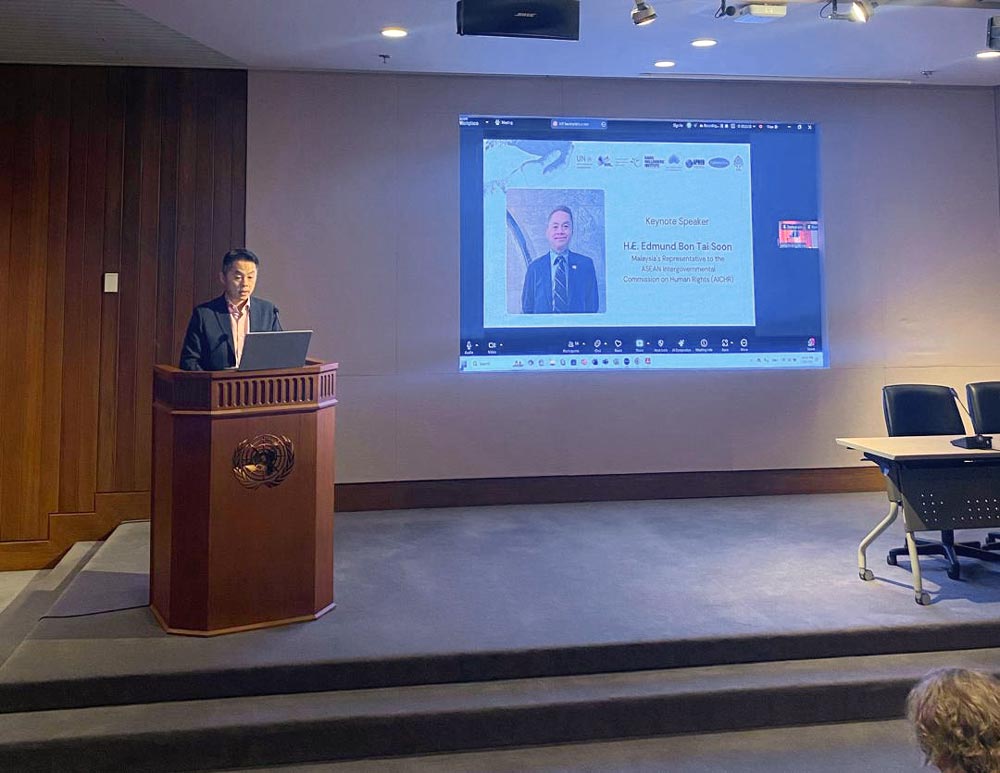
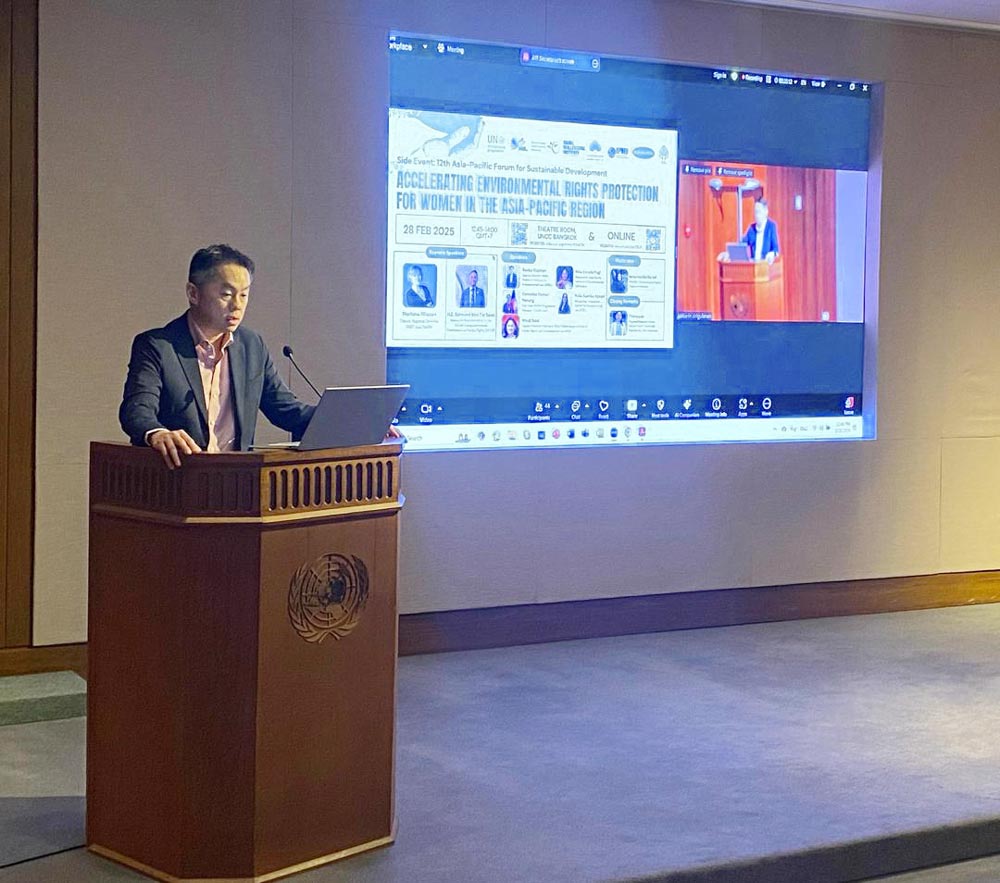
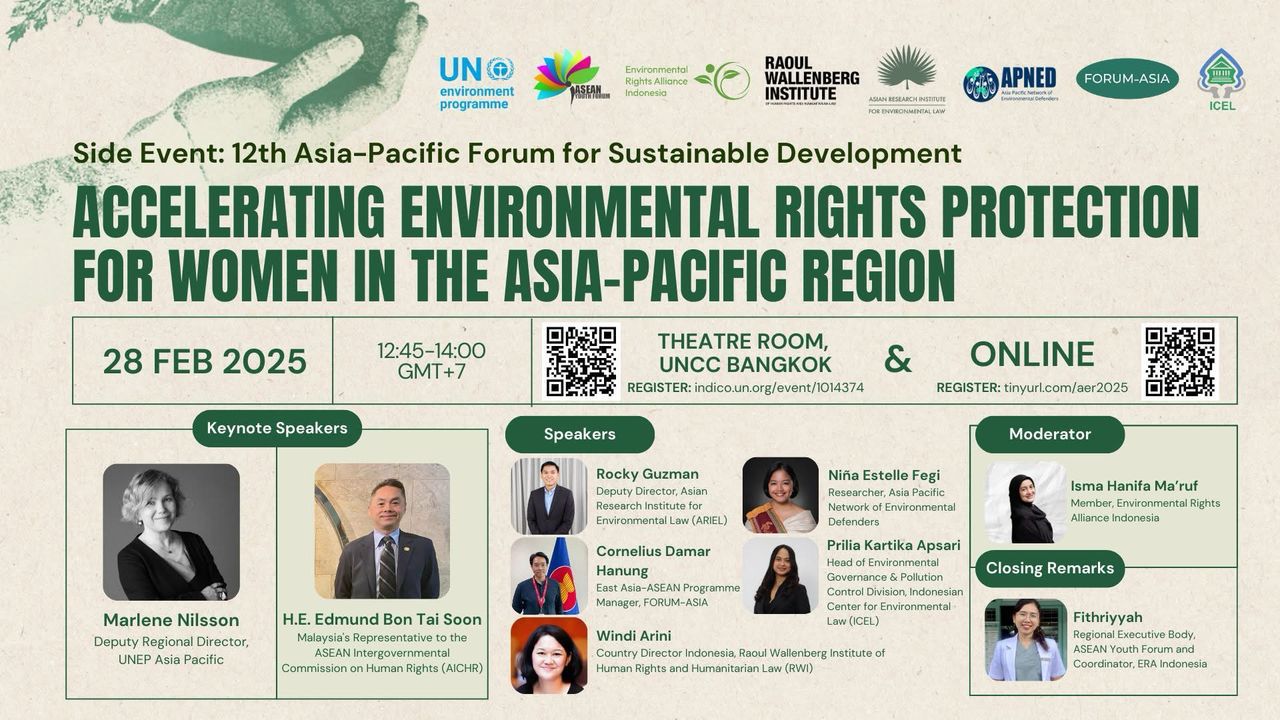
This keynote address was delivered on 28 February 2025 at the 12th Asia-Pacific Forum on Sustainable Development Goals (APFSD) side event, “Accelerating environmental rights protection for women in the Asia-Pacific region”.