By Fabian Peter | Scoop
ASEAN’s struggle to effectively manage internal conflicts within its member states remains severely limited, with the recent border dispute between Thailand and Cambodia highlighting the regional bloc’s restricted frameworks to address military clashes.
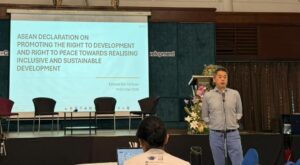
Speaking on a recent episode of Scoop Insight, ASEAN Intergovernmental Commission on Human Rights (AICHR) Chairman Edmund Bon pointed to the ongoing Thailand-Cambodia border dispute as a clear example of the regional bloc’s inability to respond effectively.
Bon, also Malaysia’s representative to AICHR, told Scoop’s editor-in-chief Terence Fernandez and news editor A. Azim Idris that ASEAN lacks the necessary tools and frameworks to act swiftly when tensions arise between member states.
“There is no template. No guidebook. When something like this happens, we are left to scramble,” he said.
Fighting had just begun along the long disputed Thailand-Cambodia border when the podcast was recorded on Thursday. At least 20 civilians were reported dead from both sides.
While both Thailand and Cambodia insisted on keeping the issue bilateral, Bon said the incident should serve as a wake-up call to ASEAN leaders.
The border conflict also exemplifies ASEAN’s struggle with its non-interference principle, he noted.
Bon argued that the principle prevents the bloc from intervening until a crisis spills over into wider regional instability.
“The conflict is right in front of us. Civilians are being hit. Yet both sides say they do not want to ‘ASEANise’ the issue,” Bon added.
“This is the problem with our non-interference principle — we cannot step in until the situation spills over to affect other countries.”

Bon stressed that Malaysia has been pushing for new human rights declarations and a five year plan that includes conflict prevention, but admitted much of ASEAN’s work still relies on quiet persuasion rather than action.
He added that some diplomats are reluctant to create formal mechanisms because they fear it could backfire in their own countries. As a result, ASEAN has had to deal with issues like Myanmar and the South China Sea in an ad hoc manner.
“We have talked about flexible engagement, but when it matters, we still get blocked. If we had a mechanism in place, we might have been able to act faster or more effectively,” he said.
During the podcast, Terence pointed out that ordinary Malaysians often view ASEAN as slow or disconnected, especially when regional conflicts lead to civilian deaths or travel disruptions.
Bon agreed, saying the regional bloc must do more to show that it is serious about protecting lives and maintaining peace — not just issuing statements.
While the situation at the time of recording remained tense, news emerged the following day that Prime Minister Datuk Seri Anwar Ibrahim had stepped in to mediate the crisis.
Anwar spoke separately with Cambodian Prime Minister Hun Manet and Thailand’s acting Prime Minister Phumtham Wechayachai.
By Friday evening, it was reported that both sides had agreed to a ceasefire and would begin pulling back their troops from the border.
Listen to the full interview here.