Abstract
In 2009 ASEAN established a human rights body — the ASEAN Intergovernmental Commission on Human Rights (AICHR) — and tasked it with promoting and protecting human rights in Southeast Asia within ASEAN’s framework of cooperation and to encourage member states to ratify international human rights treaties and act in accordance with them. AICHR has ten Representatives, one for each ASEAN member, and these individuals are tasked with fulfilling AICHR’s mandate.
In this article, we utilise the mechanisms and scope conditions contained in the revised Spiral Model to assess the opportunities and challenges that exist in aiding and frustrating their attempts to fulfil AICHR’s mandate to promote and protect human rights.
Although routinely dismissed as irrelevant in the fight for human rights in Southeast Asia, we identify that there are reasons for cautious optimism that some Representatives are making headway in making AICHR fit-for-purpose.
The article is accessible here.
Alan Collins is a Professor of International Relations in the Department of Politics, Philosophy, and International Relations at Swansea University, UK. He is the author of four single-authored books, including Building a People-Oriented Security Community the ASEAN Way, and his 18 writings on ASEAN and Southeast Asian security have appeared in International Relations, The Pacific Review, International Relations of the Asia-Pacific, and the Australian Journal of International Affairs.
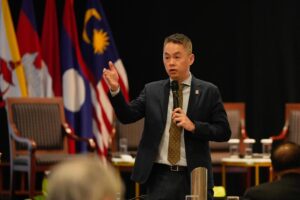
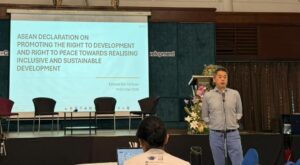
Edmund Bon Tai Soon was the former Representative of Malaysia to the ASEAN Intergovernmental Commission on Human Rights (2016–2018) and is currently a doctoral candidate in human rights and peace studies at the Institute of Human Rights and Peace Studies, Mahidol University, Thailand. He is the co-author of the Halsbury’s Laws of Malaysia on ‘Citizenship, Immigration, National Security and the Police’ (Volume 27, 2010), and is the co-founder of the well-known law blog, LoyarBurok.com, and two organisations: the Malaysian Centre for Constitutionalism & Human Rights (MCCHR) and the Collective of Applied Law & Legal Realism (CALR).
Source: The spiral model, scope conditions, and contestation in the ASEAN Intergovernmental Commission on Human Rights (Taylor and Francis Online).