
Major amendments are underway to the Communications and Multimedia Act 1998 (CMA). The amendment bill was tabled for the first reading in the Parliament on 2 December 2024.
Nestled in the bill is an amendment to the infamous section 233, a provision often used by successive governments to stifle dissent and criticism. It has been wielded against activists, opposition politicians, and human rights defenders for posting “offensive” content with the intent to “annoy” another person.
Under section 233, the bar to prove that an online posting is “offensive” is ridiculously low, with the mere “intention to annoy”. This has made prosecutions under section 233 relatively straightforward, with many convictions resulting in hefty fines and even imprisonment. The current law allows a fine of up to RM50,000 or imprisonment of up to one year following a conviction.
The law has been roundly condemned by the Malaysian Bar, SUHAKAM, human rights NGOs, and of course, the ruling coalition Pakatan Harapan back when they were in opposition, for being too vague, too wide, draconian, and prone to abuse. They were right. A lot of offensive speech is part of everyday life, and a broad range of everyday speech is criminalised under section 233 CMA. All it takes for a conviction is for the target of the content to be offended. Truth cannot be used as a defence to a charge of offence under section 233, unlike criminal defamation, which makes it all the more draconian.
Since the law is already bad, what do the government amendments attempt to do, and do they make it any better?
The government’s proposed amendments
There are a number of amendments being made to section 233 of the CMA. Some are necessary and welcomed from the government, such as criminalising online fraud and introducing protection against child sexual abuse materials and child porn. There are also troubling amendments, as highlighted by Article 19 and the Centre For Independent Journalism in their press release (archived here).
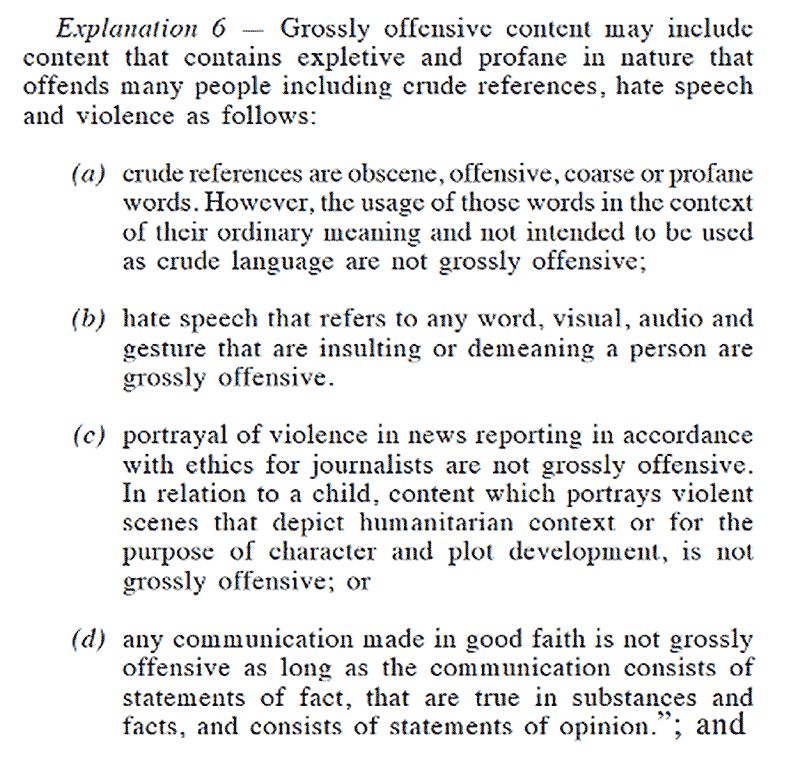
My focus today is limited to the most problematic ones as shown in the text above:
1. The amendment of “offensive” to “grossly offensive” and the illustrations to aid the interpretation of what that means; and
2. The increase in penalty from not exceeding RM50,000 to RM500,000 and imprisonment from not exceeding a year to not exceeding two years.
While the government may be credited for attempting to raise the threshold of criminality by adding the word “grossly” in front of offensive – its illustrations apply circular logic and only serve to confuse.
For example, the illustration states the following:
“Grossly offensive” includes contents that are “expletive and profane in nature that offends many people including crude references”.
“Crude references” is then defined as“offensive, coarse or profane words”.
Therefore, according to the government’s illustration:
Grossly offensive = expletives/profanities which are offensive to many which include crude references = offensive, coarse or profane words.
Forgive me, but something about the math doesn’t quite add up. The illustration given begins with what it ends with, which explains nothing.
The explanation of “hate speech” under what is grossly offensive is also vague and circular.
In this example, contents which are “insulting or demeaning a person” are examples of “hate speech”, which would be “grossly offensive”. Meanwhile, the Cambridge dictionary defines “insult” as “offensive remark or action” while “demean” is defined as “to cause someone to be less respected”.
These are very low thresholds to constitute “hate speech”, which in turn dilutes this purported higher threshold which the government seeks to achieve with “grossly offensive”.
This becomes obvious when one compares the government’s definition of “hate speech” with the United Nation Strategy and Plan of Action on Hate Speech, where “hate speech” is defined as “…any kind of communication in speech, writing or behaviour, that attacks or uses pejorative or discriminatory language with reference to a person or a group on the basis of who they are, in other words, based on their religion, ethnicity, nationality, race, colour, descent, gender or other identity factor”.
In addition, the defence of communication made in good faith, available at (d), is also worrying because it is limited to communication that “consists of statements of fact, that are true in substance and facts, and consists of statements of opinion”. This was adopted from the common law defence of fair comment. However, those who make communications which are insulting would not be covered. For example, one who calls another person a “cunt” or a “dickhead” would still be considered grossly offensive and would not have the defence of fair comment available to him.
On this note, “satire” or “parody”, even though they are exceptions to “false” communication, could nevertheless be held liable for an offence for being “grossly offensive”.
It is also very disappointing that the amendments maintained the offence of intention to “annoy” another person in the posting of “grossly offensive” content. Wanting to annoy someone should not be punishable with up to RM500,000 and not exceeding two years imprisonment.
No better
The aim of the amendments to section 233 CMA appears to be for the government to continue regulating the civility of discourse over the internet, like how previous governments applied this section. Regulating the civility of discourse over the internet is not a recognised ground for the restriction of freedom of speech and expression, and is not a legitimate aim.
In this regard, it allows for arbitrary state action because what amounts to acceptable discourse is simply that — arbitrary. The government wrongly assumes that society has a uniform standard in determining what is grossly offensive. What is grossly offensive to a particular person may not be for others. Who is to be the ultimate arbiter? The proposed amendments do nothing to improve this.
All that the government will achieve is the policing and censorship of undesirable speeches and the chilling effect over freedom of speech and expression enshrined under Article 10(1)(a) of the Federal Constitution.
I urge the government to exclude the amendments to section 233 CMA from the current bill and send this before a Parliamentary Select Committee for a thorough and detailed analysis of the amendments.
An earlier version of this article was published by MalayMail, archived here.