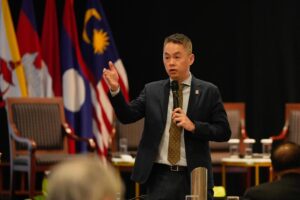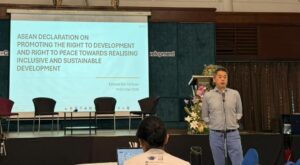

Looking through a Southeast Asian lens, I highlight one trend and one threat that impacts human rights. The economic “decoupling” between countries in the West from China is the trend, while the threat is the increasing fracture of ASEAN (Association of Southeast Asian Nations) member states’ approach to human rights.
Decoupling and labour rights
The decoupling offers opportunities for new investments in our region. At the same time, they adversely impact the enjoyment of human rights in the name of “ease of doing business”.
Southeast Asian nations are among the beneficiaries of the decoupling as we see multinational corporations moving their production bases here in recent years. One report noted that foreign direct investment (FDI) inflow into ASEAN rose 5.5 per cent in 2022 to a record USD224 billion. This inflow exceeded flows to China for a second consecutive year. Most recently, it was reported that FDI inflows into ASEAN rose to USD236 billion in 2023, a 24 per cent increase from the annual average of USD190 billion between 2020 and 2022.
One reason for this could be due to the China +1 diversification and “friend-shoring” strategies, and another reason is that operational costs are lower due to greater flexibility in wage suppression, use of short-term or casual workers, and subcontracting. Market adjustments have also encouraged cross-country subcontracting to reduce production costs.
However, subcontracting often leads to human rights violations, including lack of permanent employment, lower wages, reduced benefits, and the absence of trade unions. It also complicates supply chain traceability, undermining transparency and accountability in business practices.
These issues have severely impacted worker and community rights, contributing to income inequality. Despite regional poverty reduction, growing inequality has led to significant wealth disparity, with a small population holding most of the wealth. This disparity exacerbates marginalisation and restricts economic mobility for poorer communities. Effective distribution of wealth has not been uniform.
Unequal access to jobs and fair wages perpetuates poverty, affecting access to quality education, healthcare, and vocational training. This inequality also results in healthcare disparities, particularly among lower socioeconomic groups, leading to poorer health outcomes, higher illness rates, and lower life expectancy.
Sustainability, governance, and environmental matters
Human rights concerns are not just limited to labour rights.
We must carefully consider how decoupling affects both business operations and State conduct, as well as their relationship. Market adjustments may foster new supply chain actors and partnerships across ASEAN countries. However, some governments led by authoritarian figures engage in political repression, violate human rights, impede civil society organisations and human rights defenders, and lack strong governance structures, such as an independent judiciary, to effectively safeguard human rights.
Further, there is still limited acceptance of mandatory ESG (environmental, social, and governance) regulations, with many countries favouring voluntary measures instead. For sustainability in ASEAN to be truly effective, it must be meaningful.
Already, we are experiencing extreme temperatures and unusual weather patterns. Climate change and environmental human rights, including climate justice, are critical issues that cannot be overlooked. The turn towards Southeast Asia has intensified problems such as land grabbing and the displacement of vulnerable communities, including indigenous peoples, often without proper compensation or respect for their rights. Additionally, as businesses relocate or restructure, affected local communities frequently receive inadequate compensation or support, harming their livelihoods and rights.
Thus far, I have sketched how something external to ASEAN will impact us inside. At the same time, there is a threat to human rights within ASEAN.
ASEAN Centrality and the threat
There is fragmentation among ASEAN members on how we should approach, respect, and protect human rights. The ASEAN Charter adopted in 2007 calls for adherence to the rule of law, principles of democracy, and protection of human rights. But ASEAN Centrality on what these terms truly mean, particularly “human rights”, has yet to be established. ASEAN human rights bodies have done much work to date. However, there still seems to be disagreement about whether we need to set an interpretative precedent on how human rights should be realised in the region.
For example, what does respect for environmental human rights entail? ASEAN cannot comprehensively address climate change and biodiversity loss without considering human rights. Yet, the ASEAN baseline position on whether environmental human rights include access to information, the right to public participation, and indigenous peoples’ protection is unclear.
Intra-ASEAN, some want to benefit from regionalism purely for economic growth but will not want to be governed by the same organisation regarding human rights. Therefore, ASEAN Centrality to move forward on human rights is lacking and not evident.
Speaking about business and human rights, ASEAN should, at the very least, attempt to discuss the human rights obligations of Corporate ASEAN when doing business. The United Nations Guiding Principles on Business and Human Rights 2011 have not found a firm footing in ASEAN. They have not yet been vernacularised to regulate business practices in the region. ESG and sustainability reporting are making a small dent in favour of corporate accountability. However, the pull towards mandatory human rights due diligence laws is weaker than the push against it. At times, human rights are strategically blocked from appearing in ASEAN documents, and the practice of bureaucratic procedures stalls any progress.
Interestingly, countries with greater civic space, active civil society organisations, and robust democracies are also pushing for stronger rules, governance mechanisms, and effective accountability within ASEAN to protect human rights and combat corruption consistent with international law. Unfortunately, some governments will invoke international law to suit their purposes, such as calling on the atrocities in Myanmar to stop, but conveniently disregard international law on other human rights matters.
Conclusion
Granted the customary reluctance to have binding rules or mechanisms, ASEAN should not fear human rights but bravely embrace its recognition by aspiring and committing to higher standards. Limiting the adverse impacts caused by businesses, using human rights tools, makes us more responsible, ethical, and sustainable. Only then can we say we have achieved ASEAN Centrality, which will adequately safeguard the needs, wants, and rights of the peoples of ASEAN as we attempt to further the trajectory of economic development in the region.
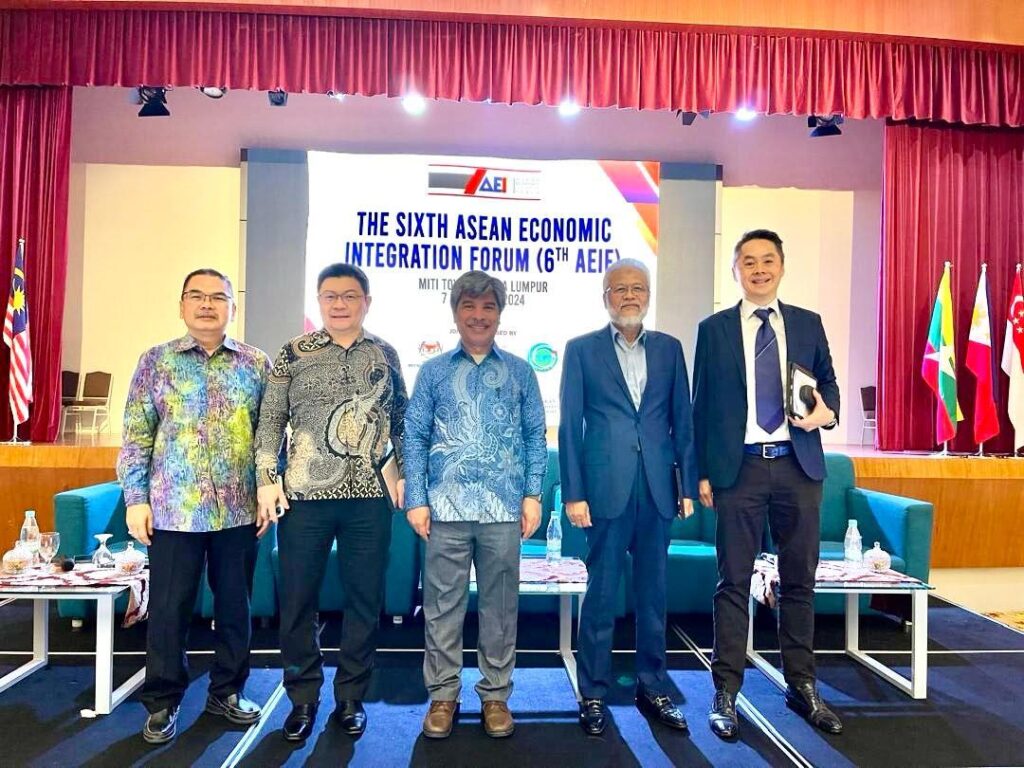
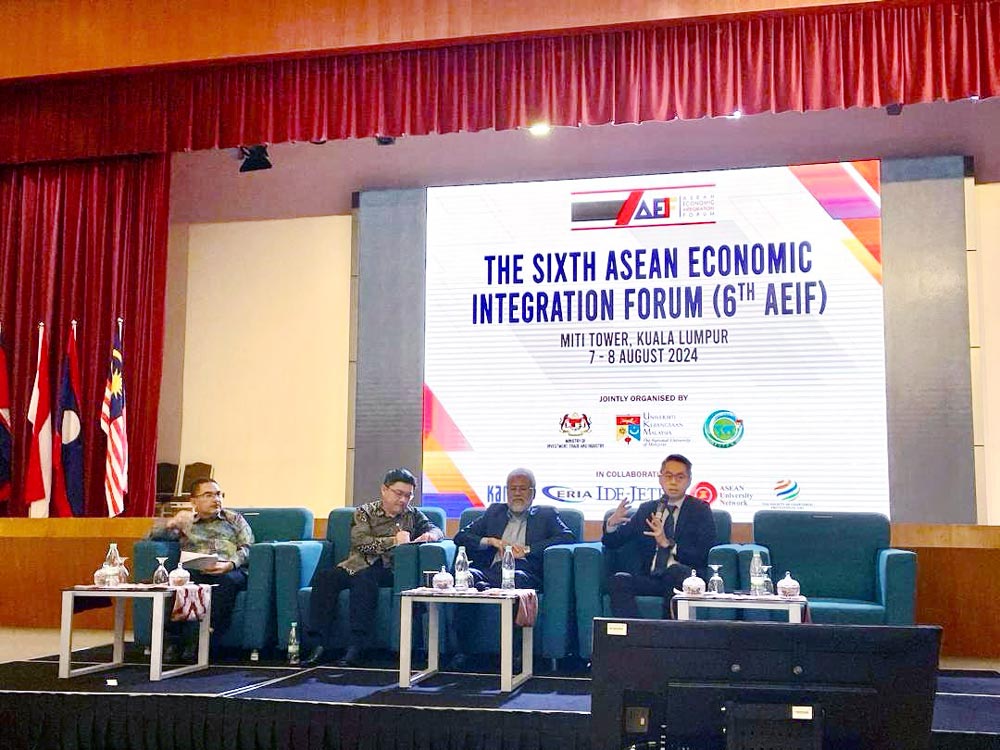
This article was adapted from remarks by Edmund at the “High-Level Dialogue: Reflecting the Megatrends – Geopolitics, Geoeconomics and ASEAN Centrality” during the 6th ASEAN Economic Integration Forum (AEIF), in Kuala Lumpur on 8 August 2024. The event, held from 7 to 8 August, was co-organised by the Ministry of Investment, Trade and Industry (MITI) and Institute of Malaysian and International Studies (IKMAS), National University of Malaysia (UKM).