By Kiran Jacob | The Edge Malaysia

Nearly 100 households in Kampung Sena, Mukim Bebar, Pekan, are facing eviction following legal proceedings that claimed that the villagers have been occupying and building structures on the agricultural land without permission.
Court documents sighted by ESG show that the Pahang state government granted a 99-year lease in 2021 to private title holders for oil palm cultivation. Notices served to villagers in early August 2025 ordered them to demolish their homes and structures or face legal action.
But a villager from the Jakun community tells ESG that they have lived on the land for generations and the landholders had never once met with the village leaders. “Our community has not given consent to any party to carry out projects on our land. This is an intrusion,” he says.
This is not an isolated incident. Indigenous communities in the country face violation of land rights, trespass over customary land, denial of land ownership, relocation, land dispossession and displacement without their agreement, according to a report by the Human Rights Commission of Malaysia (Suhakam).
The report titled “The rights of indigenous peoples in Malaysia: The United Nations Declaration on the Rights of Indigenous Peoples (UNDRIP) and the law in Malaysia” further states that development programmes on indigenous land such as agricultural projects and resettlement schemes are often carried out without due consultation or meaningful participation of the communities themselves.
This underscores the need for proper, mandatory and standardised Free, Prior and Informed Consent (FPIC) processes at the national level that are enshrined in law.
“FPIC is one of the major principles, if not the most important principle, that can secure indigenous self-determination and indigenous rights,” says Dr Colin Nicholas, founder and coordinator of the Centre for Orang Asli Concerns, a non-governmental organisation.
The FPIC process enables an indigenous or local community to exercise its fundamental right to give or withhold consent to all proposed activities, projects, legislative or administrative measures and policies that will take place in or impact their lands, territories, resources or livelihoods, according to the UNDRIP.
FPIC is grounded in the substantive realisation of indigenous collective rights such as the right to self-determination; right to lands, territories and resources; right to cultural integrity; and right to participate in decision-making.
However, FPIC for indigenous communities is not expressly recognised in Malaysian law except in the biodiversity context.
This means FPIC does not apply to land and development projects, which leaves indigenous communities vulnerable to encroachment, relocation or development without meaningful consent, according to people ESG spoke to.
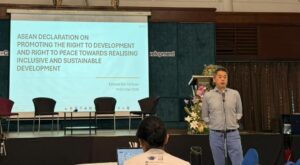
For FPIC to be effective, it must be written into law, supported by clear guidelines and applied genuinely to secure both consent and equitable benefits for indigenous peoples, says Edmund Bon, head of chambers (civil) at AmerBON Advocates, and Malaysia’s representative to the Asean Intergovernmental Commission on Human Rights.
Countries such as Colombia and Peru have introduced legal frameworks that move toward binding FPIC obligations. In Colombia, the right to FPIC is rooted in the country’s constitution and reinforced through numerous constitutional court rulings. In Peru, the Wampis Nation operates under an autonomous statute that legally requires FPIC for all projects, with courts halting activities that proceed without it.
The Wampis Nation is an indigenous people of the northern Peruvian Amazon who declared the creation of their own autonomous territorial government in 2015.
June Rubis, global council co-chair for documenting territories for the ICCA Consortium and co-founder of Building Initiatives in Indigenous Heritage, which is a social enterprise, says Malaysia could follow suit by embedding FPIC obligations directly into national legislation and ensuring operational safeguards for projects.
This includes clear terms of reference with provisions that allow suspension or withdrawal of consent if FPIC is violated; mechanisms for restitution where communities are harmed; and requiring companies to plan in advance for scenarios where consent is withheld or withdrawn.
Malaysia’s National Action Plan on Business and Human Rights recommends developing national FPIC guidelines, legislating FPIC at the federal level and aligning Malaysia’s laws with UNDRIP.
Hard to implement FPIC without a law
For the time being, FPIC in Malaysia is not yet a legally binding requirement in domestic law, but courts have recognised international customary law and principles of UNDRIP in cases.
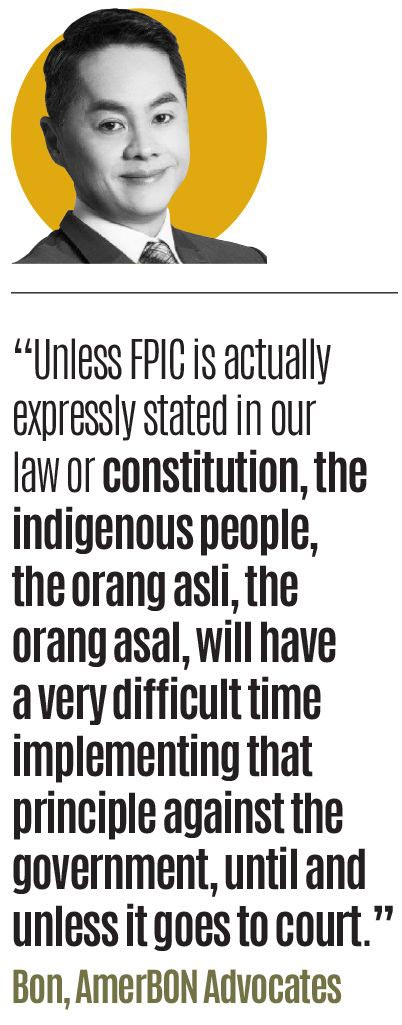
This means that indigenous peoples face a difficult and resource-intensive process of litigation to implement FPIC, says Bon. “Unless FPIC is actually expressly stated in our law or constitution, the indigenous people, the orang asli, the orang asal, will have a very difficult time implementing that principle against the government, until and unless it goes to court,” he says.
“Without FPIC, land conflicts are likely to intensify. While communities can take legal action to claim land or demand compensation, consequences only arise after projects begin, defeating FPIC’s purpose.”
Bon says this also places a heavy burden on indigenous communities, who must prove their rights and ancestral claims in court. They must demonstrate ancestral occupation and land rights in order to stop projects, rather than the state or companies having to prove that the land is not indigenous territory.
But the burden of proof should be reversed, where states or companies have to demonstrate that a particular piece of land is not indigenous land, says Bon. “Companies or states, please prove your case that it is not indigenous land. You must assume it’s indigenous land.”
This is why it is crucial for there to be proper mapping of indigenous lands, says Bon. Failure to clearly map and recognise indigenous territories allows states to designate such areas as “state land” and grant permits to companies for projects without consent, causing direct harm to indigenous livelihoods and sparking conflict.
In this regard, the main barrier is the government’s reluctance to recognise indigenous land rights, as this would take away state land, he adds.
“I think the government is very reluctant to recognise indigenous peoples’ land [because] if you recognise orang asli or orang asal land, it will take away state land. The conflicts arise now because the state doesn’t want to or doesn’t recognise indigenous land. They just say that [it is] state land. [The state then] gives [the company] the permit to go and do whatever they want to do. Of course, when you impact the indigenous people, where are they going to go? They’re going to fight,” says Bon.
The issue is further complicated by overlapping jurisdictions. The federal government is tasked with protecting indigenous peoples, but land matters fall under state authority. “So, until there is sincere political will to amend the law, to regularise all this, it will never happen,” says Bon.
This means there is a need to work hand in hand with state governments, notes ICCA’s June. “Until state and local governments take it seriously, it’s really hard for the national government to make that shift,” she says.
Still, enshrining FPIC in federal law would be an important first step, she says. It would send a clear signal of Malaysia’s seriousness about indigenous rights. Even if state alignment remains difficult, a strong federal framework would demonstrate credibility, strengthen oversight and lay the foundation for future cooperation with state governments.

A right to say no to proposed projects
True FPIC must allow indigenous peoples to reject projects, say the interviewees. In fact, the “highest hanging fruit” of FPIC is actual informed consent, meaning communities can reject projects outright.
But many companies and governments currently treat FPIC as a mere procedural exercise, simply “ticking the boxes” rather than engaging meaningfully with indigenous communities, says June. This is with the goal of securing an eventual buy-in and the assumption that the process must lead to a “yes”.
Bon adds: “Government agencies may consult only village heads and offer compensation without genuine community consent, while companies often present projects as a fait accompli. [For instance], in carbon credit projects, profits go to companies and states, while affected communities see little to no financial benefit.
“What will happen is they go to the [village heads] and then they say, look, I have got this project. This is the compensation. Then the [head might] say, I want a higher compensation. It’s as if indigenous communities cannot say no. It’s just a question of how much the compensation is.”
Companies also use pressure tactics such as imposing deadlines, withholding critical information or offering conditional benefits to get this consent, says June. “They say if you want your schools and roads, you won’t get it unless you give us a yes. That undermines the whole FPIC process,” she adds.
“There’s a lot of cases where communities already say no. And then companies will [say], we’ll see you back in six months, and they try again, which is very exhausting for the community. Eventually, they weigh down the community and [the people] will say yes.”
Real consent is based on self-determination and empowerment, adds Colin. Self-determination means indigenous communities must be free to decide what is best for them. Meanwhile, empowerment is the ability to make a decision when multiple options are available, based on their own understanding and desires.
“If the orang asli are not empowered in a process like this, their ability to decide for themselves what’s best for them, then that process cannot be considered a true FPIC process for me,” says Colin.
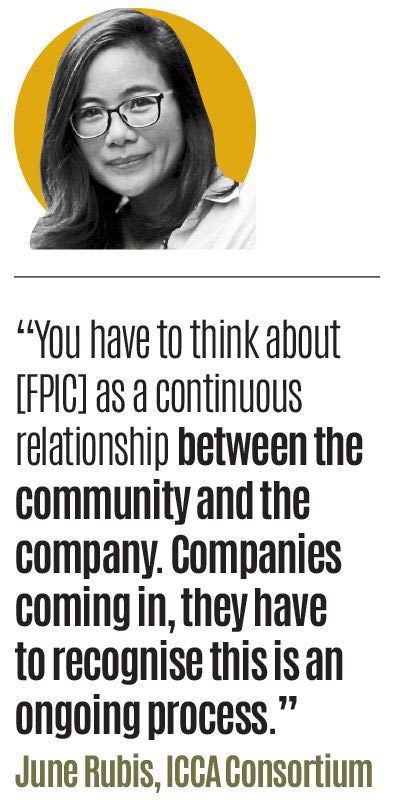
June adds that a community’s consent can change over time as they gain more knowledge and awareness.
“You have to think about it as a continuous relationship between the community and the company. Companies coming in, they have to recognise this is an ongoing process. So they may get, for example, a yes, you know, in the first round. But then if the communities start learning more, and they become more aware of their rights, then they may say no. And the companies have to respect that, the state has to respect that,” she says.
Essentially, achieving true consent is difficult and requires long-term relationship building, says June. Companies must invest in sustained engagement with communities, not one-off consultations.
This means empowering communities with independent expertise and resources as well as recognising their right to create their own “community protocols” to set the terms of engagement.
These protocols are developed by the communities, which outline the terms of engagement, including timelines, meeting agendas and the resources needed for a fair consultation. Critically, these protocols also articulate the community’s aspirations for development and the benefits they hope to receive, such as schools or other forms of compensation.
UNDRIP Articles on FPIC
Free, Prior and Informed Consent (FPIC) is central to the United Nations Declaration on the Rights of Indigenous Peoples (UNDRIP).
It affirms that Indigenous peoples have the right to decide what happens on their lands and territories and that states and companies must obtain their genuine consent before approving projects, policies or activities that affect them. Here are some of the key articles where FPIC are recognised:
Article 10: Indigenous peoples shall not be forcibly removed from their lands or territories. No relocation shall take place without the FPIC of the indigenous peoples concerned and after agreement on just and fair compensation and, where possible, with the option of return.
Article 11(2): States shall provide redress through effective mechanisms, which may include restitution, developed in conjunction with indigenous peoples, with respect to their cultural, intellectual, religious and spiritual property taken without their free, prior and informed consent or in violation of their laws, traditions and customs.
Article 19: States shall consult and cooperate in good faith with the indigenous peoples concerned through their own representative institutions in order to obtain their free, prior and informed consent before adopting and implementing legislative or administrative measures that may affect them.
Article 28(1): Indigenous peoples have the right to redress, by means that can include restitution or, when this is not possible, just, fair and equitable compensation, for the lands, territories and resources, which they have traditionally owned or otherwise occupied or used, and which have been confiscated, taken, occupied, used or damaged without their free, prior and informed consent.
Article 29(2): States shall take effective measures to ensure that no storage or disposal of hazardous materials shall take place in the lands or territories of indigenous peoples without their free, prior and informed consent.
Article 32(2): States shall consult and cooperate in good faith with the indigenous peoples concerned through their own representative institutions in order to obtain their free, prior and informed consent prior to the approval of any project affecting their lands or territories and other resources, particularly in connection with the development, utilisation or exploitation of mineral, water or other resources.
This article first appeared in The Edge Malaysia Weekly on September 29, 2025 – October 5, 2025.