By Siva Selan | Eco Business
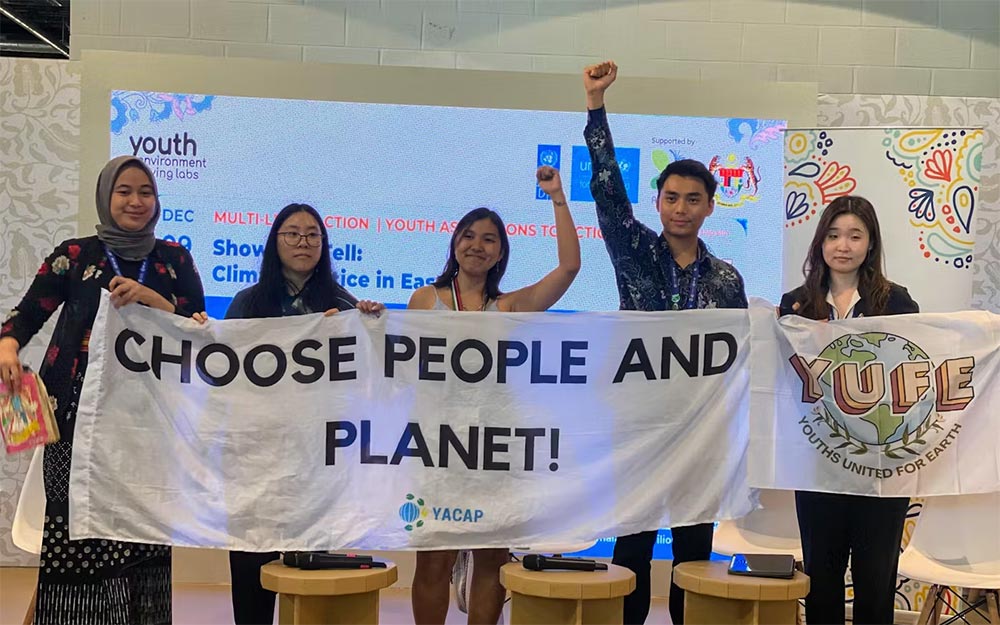
For many, environmental awakening begins in a classroom through formal education. But for Max Han Kai Ding it was rooted in the soil of Tampin, a small town in Negeri Sembilan where he spent his childhood running barefoot around his grandmother’s backyard, under the shade of a rambutan tree.
“What really inspired me was not a particular moment, but a relationship that was rekindled as I grew older,” he said. “It’s the sacred tie to land and the environment that I believe every Southeast Asian holds.”
This deep connection to land, combined with personal experiences of transboundary haze that left him hospitalised multiple times as a child, sparked in Han a lifelong commitment to climate justice. “I remember feeling angry, blaming Indonesia naively, as many Malaysians did. But I now understand that it’s a systemic issue, and sadly, this is the story of many Malaysians and Southeast Asians,” he said.
. . .
Given the delay of the ASEAN Environmental Rights Declaration, how are you ensuring that the final draft will be more inclusive and robust? Does Malaysia’s ASEAN chairmanship help advance the inclusivity agenda?
The problem with ASEAN is that everything needs to be unanimously decided. This is a huge risk when you’re lobbying for something. If we ask for something too ambitious and one member doesn’t want to sign on, the document becomes a stalemate and gets discarded. So, there’s a lot to consider when pushing for a draft that’s more inclusive or robust. One way we’ve approached it is with data.
This can be contentious, because while we push for data and evidence-based advocacy at the international level, like using language from the UN Declaration on the Rights of Indigenous Peoples (2007), some ASEAN leaders argue that just because it exists internationally doesn’t mean it can be passed in ASEAN. They want to see that it has already been adopted in ASEAN, which was a difficult position to be in if no regional document has addressed it before. So, we had to get creative with legal evidence, showing where ASEAN has previously used certain terms, like “Indigenous peoples”, which is highly contested in ASEAN because it holds different political weight in different countries.
We have gone through the painstaking process of extensive research to ensure the final draft is more inclusive and robust, backed by evidence and data. If that doesn’t work, the next stage would be strategic lobbying across the region. I’m glad that media like Eco-Business have reported on these issues which helps us create awareness publicly. ASEAN processes are usually kept behind closed doors so when more people are aware of them, they can pressure their governments to sign the declaration.
On Malaysia’s ASEAN chairmanship, I think we’ve been more silent in the past, but with representatives like Edmund Bon, and more momentum for climate action, things are shifting. Our budget has increasingly allocated money for conservation and environmental change, and our ministries have become more vocal on climate action for the Global South.
Environment minister Nik Nazmi has also expressed support for passing this environmental rights declaration. Malaysia has the power as chair to push this agenda forward. If we can get it passed during our term, it would fit the theme of inclusivity and sustainability. I think Malaysia needs to put its foot down politically, in a way that is both firm and palatable, to really push this declaration forward without compromising on the five core principles. This is the bare minimum. It was supposed to be legally binding and now it’s not, but even as a non-binding declaration, it’s still an important frame of reference for communities.
. . .
Click here to read the full article.
Max Han Kai Ding was one of eight sustainability leaders selected for the Eco-Business Sustainability Youth A-List 2025.