By Rahmat Khairulrijal | New Straits Times
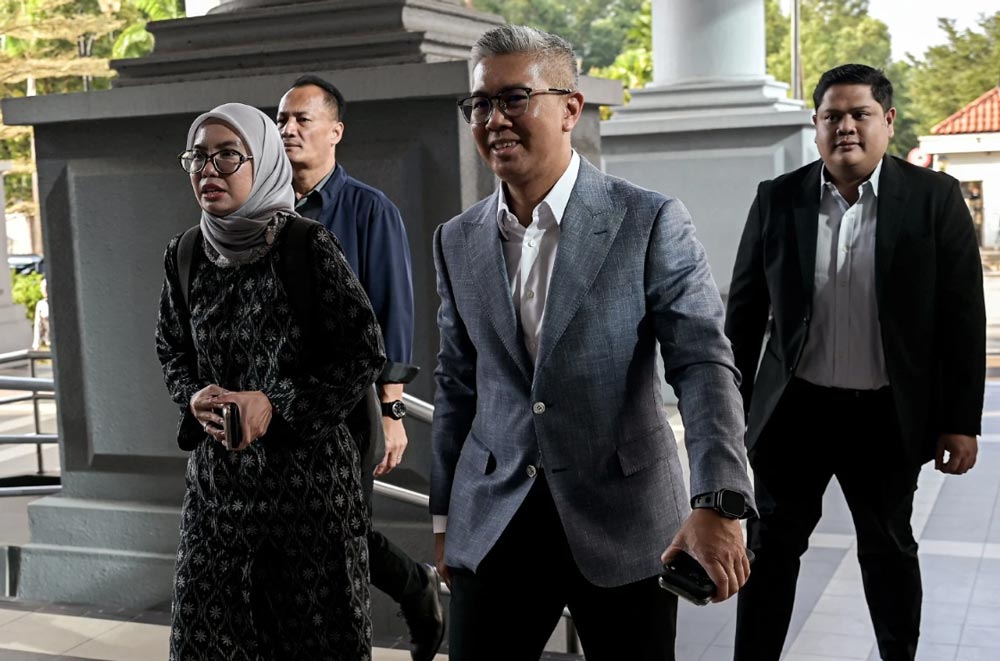
Former prime minister Tan Sri Muhyiddin Yassin did not interfere in the process of awarding projects under the Jana Wibawa programme, the High Court heard today.
Former finance minister Tengku Datuk Seri Zafrul Tengku Abdul Aziz said this while testifying as key prosecution witness in Muhyiddin’s trial involving seven charges — four counts of abuse of power and three counts of money laundering linked to the programme.
Under cross-examination by Muhyiddin’s lawyer Datuk Amer Hamzah Arshad, the witness also agreed that the accused never interfered in an evaluation process conducted by the Jana Wibawa programme Contractor Evaluation Committee.
Tengku Zafrul said the committee would conduct the assessment and subsequently make recommendations, while the final approval would be decided by the Finance Ministry.
Amer Hamzah: In the process that you described, was there any interference by the prime minister?
Tengku Zafrul: Based on my knowledge, no.
Yesterday, Tengku Zafrul testified that KCJ Engineering Sdn Bhd, a company alleged to have contributed RM800,000 to Bersatu, had initially failed the Finance Ministry’s evaluation for a Jana Wibawa programme before eventually securing a RM62 million contract.
He said the engineering and construction firm later passed its second assessment and was recommended for the project following the committee’s decision at a meeting on Feb 26, 2021.
Tengku Zafrul agreed with Amer Hamzah’s suggestion that there was nothing suspicious about the committee’s overall process.
According to Tengku Zafrul, it was a normal evaluation process that was also undergone by other companies and not only KCJ Engineering.
Tengku Zafrul also agreed with Amer Hamzah’s suggestion that every meeting minute was not an instruction and acknowledged that he had received many such minutes from Muhyiddin.
He said this when referred to the document titled “Proposal for the Appointment of 54 Implementing Contractors for the Implementation of 54 Projects Under the Jana Wibawa Programme Through Direct Negotiation (Design & Build)”, which also listed the names of contractor companies.
He also agreed with the lawyer’s suggestion that there was no evidence presented by the prosecution showing that Muhyiddin had any personal or financial interest in the company involved.
When it was suggested that all the projects could not be implemented by a minister alone but required approval from higher authorities, the witness replied: “Yes.”
According to Tengku Zafrul, there was a need to create an economic stimulus package to generate employment opportunities during the Covid-19 pandemic, and he agreed that all the projects could not be implemented by a single minister.
Tengku Zafrul also agreed that contractors were “severely affected” at the time and that assistance given to them would create a “trickle-down effect” on the economy.
“You could see the problems faced by the Small and Medium Enterprises (SMEs) sector, Bumiputera businesses, contractors and the entire ecosystem.
“Based on those interests and concerns, that was why we proposed Jana Wibawa,” he said.
Jana Wibawa was introduced in 2020 to speed up economic recovery from the Covid-19 pandemic through infrastructure and public works projects awarded to Bumiputera contractors via direct negotiations and pre-qualified tenders.
Muhyiddin, who is Bersatu president and Pagoh MP, faces four charges of abuse of power involving RM232.5 million in alleged gratification for the party, and three counts of money laundering involving RM200 million.
The trial before Judge Noor Ruwena Md Nurdin continues tomorrow.