By Tan Zhai Yun | The Edge Malaysia

By now, Malaysia has a few major road maps and strategies to guide the country towards a low-carbon economy, touching on the energy, biomass, mobility and waste sectors, to name a few.
Some are high level, while others involve mandatory actions, such as on sustainability reporting and, potentially, carbon taxes for high-emitting sectors.
These will be essential to bring Malaysia towards its long-term climate and sustainability goals, as well as its vision for a fair and equitable society, as outlined in the 13th Malaysia Plan (13MP).
However, there are concerns about the nation’s long-term commitments to the energy transition and climate targets, given the uncertain global political and economic conditions as well as lack of details on some of the upcoming plans.
The resignation of minister of natural resources and environmental sustainability Nik Nazmi Nik Ahmad also left questions about continued leadership in this area.
ESG sought out a few key ministries and regulators for their thoughts on these matters, and what businesses can expect.
Full steam ahead with energy transition
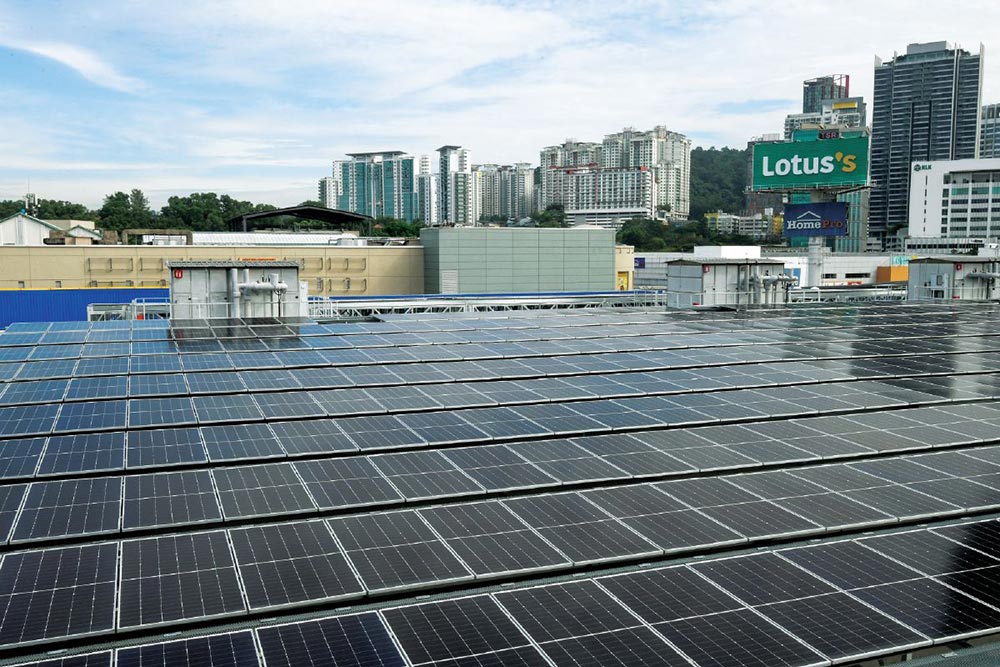
In the past year, there have been many key announcements from the Ministry of Energy Transition and Water Transformation (Petra), such as the adjustment of electricity tariffs, expansion of initiatives to increase renewable energy (RE) penetration and approvals for new large-scale solar (LSS) projects.
This could be seen as progress towards goals outlined in the National Energy Transition Roadmap, which aims to achieve 70% of RE in installed capacity by 2050.
Datuk Seri Fadillah Yusof, deputy prime minister and minister of Petra, calls ESG a “strategic necessity to future-proof our economy and secure long-term growth” in an email response to ESG, and emphasised the need for an ambitious and just energy transition.
Solar power and energy efficiency are low-hanging fruit in the energy transition. However, addressing the concern that LSS could result in deforestation, Fadillah says land use for solar development must be managed carefully.
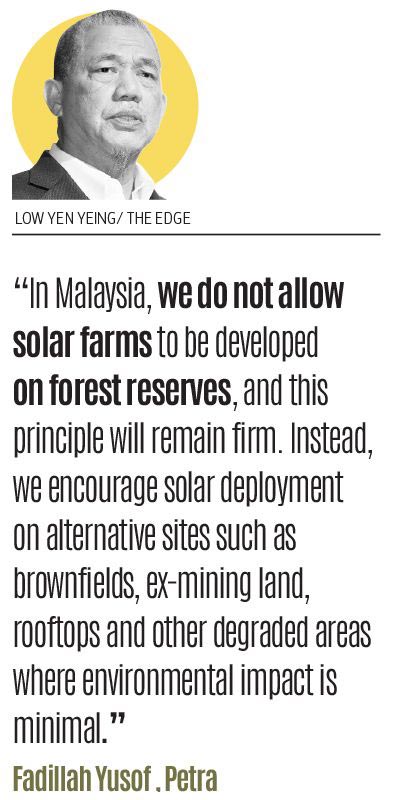
“In Malaysia, we do not allow solar farms to be developed on forest reserves, and this principle will remain firm. Instead, we encourage solar deployment on alternative sites such as brownfields, ex-mining land, rooftops and other degraded areas where environmental impact is minimal,” says Fadillah.
“A specific solar farm development guideline has also been published by the government, which serves as a reference for state planning authorities. By prioritising such sites, Malaysia can expand RE capacity while safeguarding our forests and ecosystems.”
Beyond solar energy, Fadillah highlights the potential of biomass but acknowledges the challenges of obtaining consistent and sufficient feedstock.
“At present, much of our biomass is exported in raw form, including woodchips and palm residues, which other countries then process into higher-value energy products. This indicates both the opportunities and gaps that we need to address locally,” he notes.
“Looking ahead, Malaysia can certainly aim higher. Beyond traditional combustion, there is potential in developing more advanced uses of biomass such as biofuels, biorefining and co-firing solutions. To realise this, we need better feedstock aggregation, stronger logistics and investment in conversion technologies.”
Natural gas is expected to play a prominent role in the energy transition in the near to medium term, to balance out the intermittent nature of RE. But its role can be reduced, says Fadillah, if RE penetration increases and is supported by grid modernisation, battery storage and energy efficiency measures.
How to overcome the high cost of nuclear and green hydrogen?
As for the newer forms of green technology, Petra is conducting a feasibility study on nuclear energy, including small modular reactors (SMRs) to provide a stable load to the grid. However, SMRs are still new and expensive.
When asked, Fadillah says Malaysia must study all options to ensure a sustainable, low-carbon energy mix is aligned with its net zero goals. This effort will be led by MyPower Corp as the Nuclear Energy Programme Implementing Organisation, guided by the International Atomic Energy Agency standards.
“Large conventional reactors (LCRs) face high capital costs and long construction timelines but are reliable and resilient to fuel price volatility. SMRs offer potential benefits like lower upfront costs and flexibility but remain at an early development stage, requiring further validation,” he says.
“For Malaysia, LCRs could replace coal plants by 2044, while SMRs may complement RE, storage and hydrogen in the future.”
Green hydrogen is another transformative new technology that could benefit hard-to-abate industries like heavy transport, shipping and industry. Sarawak is taking the lead: the state is to export the first batch of solid green hydrogen to Singapore this year.
However, this is an expensive technology.
“One way forward is to focus on developing local demand clusters — for example, pairing hydrogen production with industrial hubs, ports or large transport fleets — so that economies of scale can be achieved in both supply and usage,” says Fadillah.
“What Petra would like to see at the national level is the implementation of the Hydrogen Economy and Technology Roadmap that the government has launched, which sets out Malaysia’s role in production, domestic utilisation and export.”

Climate change bill and more ambitious NDC in the works
The new acting minister of natural resources and environmental sustainability (NRES) is Datuk Seri Johari Abdul Ghani, who is also the minister of plantation and commodities. While he was unable to grant ESG an interview before press time, the ministry responded to several questions on the much-awaited climate change bill (RUUPIN) and other matters.
RUUPIN is still expected to be passed within this year, says the ministry, which is working closely with the Ministry of Finance (MoF) to align the emissions trading scheme (ETS) — proposed in RUUPIN — with the carbon tax, which is under the purview of MoF.
“The reporting requirements under the [proposed Climate Change] Act will also serve as the basis for the carbon tax framework. Future regulations and policies on carbon tax will be harmonised with the provisions of the Act to ensure consistency and effective implementation,” says NRES.
Meanwhile, the Ministry of Economy is developing the National ESG Strategic Plan. Will the plans overlap?
NRES responded that it is working with the relevant ministries to ensure policies are complementary.
“Ultimately, all these initiatives are focused on building a consistent reporting framework that enables Malaysia to effectively track and demonstrate its climate commitments, both globally and domestically,” says NRES.
“This is why, under RUUPIN, we will enhance the National Climate Change Council so that it will be the highest platform to ensure alignment not only between federal agencies but also state governments.”
Meanwhile, as a party to the United Nations Framework Convention on Climate Change (UNFCCC), Malaysia must increase its nationally-determined contribution (NDC) target this year. NRES says it started preparing NDC 3.0 last year to ensure it is ambitious, realistic and aligned with the upcoming 13MP.
NDC 3.0 will include adaptation information to address climate risks, NRES adds, and will be supported by a Gender Action Plan, Just Transition Action Plan and finance and investment strategy.
“The NDC itself is complete but is now undergoing the high-level approval process. Unfortunately, we will miss the Sept 22, 2025 deadline but plan to update our progress during the UN Secretary-General’s Climate Summit at the UN general assembly. Once cabinet approval is secured in early October, Malaysia will submit its NDC 3.0, which we hope will be counted in UNFCCC’s synthesis report,” says NRES.
Details on NDC 3.0 will be unveiled at COP30 in Belem, Brazil, later this year.
Public listed companies leading the way in sustainability reporting
In Malaysia, only public listed companies (PLCs) and large non-listed companies (NLCOs), pending some legal amendments, are mandated to prepare sustainability reporting.
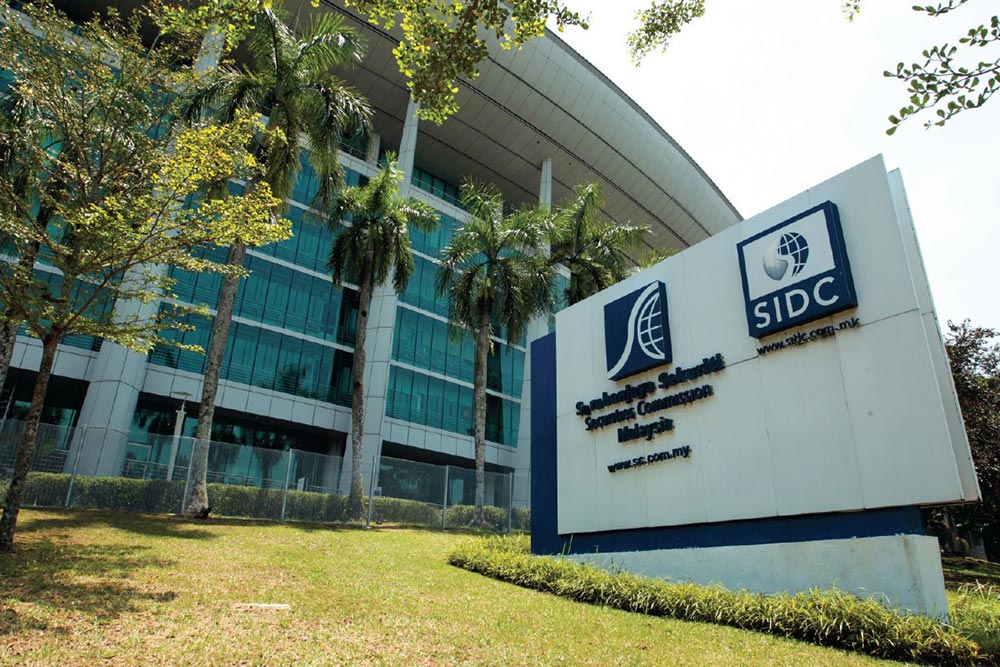
It started in 2015, when Bursa Malaysia amended listing requirements for Main Market PLCs, requiring them to include a sustainability statement in their annual reports. Last year, Malaysia formed the Advisory Committee on Sustainability Reporting (ACSR), chaired by the Securities Commission Malaysia (SC), which then launched the National Sustainability Reporting Framework (NSRF).
The framework aligned mandatory sustainability reporting — not just from PLCs now, but also NLCOs — with the latest global standards from the International Sustainability Standards Board (ISSB).
Priority is to stay on track with NSRF timeline
The first batch of PLCs — those listed on the Main Market with a market capitalisation above RM2 billion — must comply with the NSRF this year, while the rest of the Main Market PLCs must start next year.
Even then, climate-related disclosures are permitted only on principal business segments, while Scope 3 emissions are not necessary until 2027. That is when full compliance is needed.
However, it is not uncommon to hear grouses from businesses about how the sustainability reporting process is costly, due to the hiring of consultants and assurance professionals.
When asked, the SC says the NSRF was planned by carefully considering challenges companies may encounter in adopting ISSB standards.
The current pace of adoption, following the phased approach, is meant to make the adoption process more manageable for companies, adds SC chief sustainability officer Neetasha Rauf.
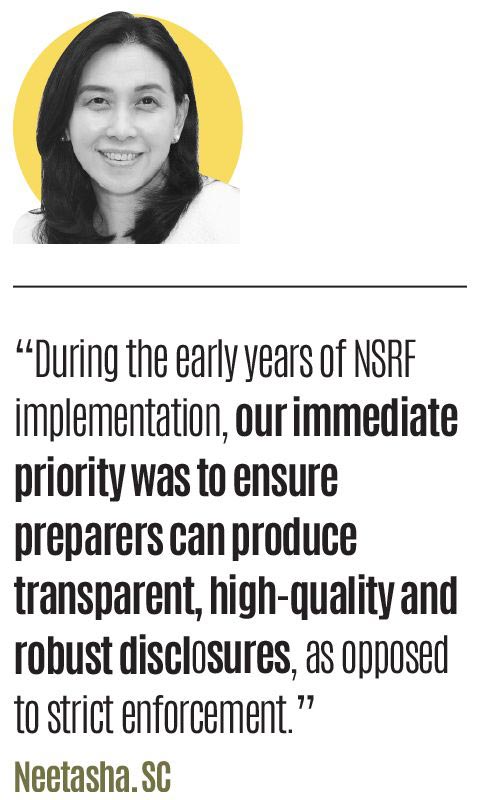
“During the early years of NSRF implementation, our immediate priority was to ensure preparers can produce transparent, high-quality and robust disclosures, as opposed to strict enforcement,” says Neetasha.
Meanwhile, the ACSR’s PACE (policy, assumptions, calculators and education) initiative offers capacity building for companies, whether through engagement sessions, specialist workshops, interoperability modules training with the Global Reporting Initiative or via a chatbot function on the NSRF microsite.
“Leveraging our established working relationship with the ISSB, we are actively encouraging more frequent engagements in Malaysia to facilitate direct dialogue with our preparers, ensuring clarity in guidance and the timely identification of practical solutions. We have a few capacity-building engagements with ISSB scheduled in the next month,” says Neetasha.
“We believe these efforts are being well received and that we are on track to implement the NSRF over three years as planned. The ACSR will continue to closely engage with preparers to solicit feedback on their reporting challenges.”
Meanwhile, Bursa highlights its Central Sustainability Intelligence (CSI) solution, which offers guided and built-in templates aligned with ISSB’s standards and the Simplified ESG Disclosure Guide to PLCs for free. It also has tools to enable Scope 3 emissions reporting and supplier engagement.
“By providing these functionalities in one place, CSI helps companies gradually build internal capabilities and reduce long-term reliance on external parties on meeting such requirements,” says the regulator.
Expanding to non-listed companies
For non-listed companies, laws such as the Financial Reporting Act 1997 and Companies Act 2016 must first be amended before they can be mandated to prepare sustainability reports.
Some of these companies, however, are already doing their own measurement and reporting due to demands from global clients, banks and investors.
Small and medium enterprises (SMEs) are also stepping onto this journey, even though they are not mandated by law. However, they are part of the supply chain of PLCs, which need data from SMEs to report on their Scope 3 emissions.
Bursa says that while reporting requirements mainly concern PLCs, it is encouraging the companies to “cascade good sustainability practices by inviting their suppliers, vendors and other value-chain partners, including SMEs, in their reporting process”.
While there have been some movement globally for companies to start reporting on biodiversity matters, the SC’s focus is on the NSRF for now.
“There are currently ongoing discussions on further disclosures in areas such as biodiversity and impact reporting, which we are tracking and analysing. We understand adopting these standards is difficult, especially for companies operating across different jurisdictions. We have no immediate plans to adopt those requirements, as our focus is still on ‘climate first’,” says Neetasha.
“Looking ahead, we encourage PLCs further along in their sustainability reporting journey to work towards more ambitious targets, granular data collection and more proactive consideration of areas beyond climate-related disclosures.”
This was echoed by Bursa, which added that collaboration with the supply chain to measure carbon emissions should come next, and that companies should start to articulate clear transition pathways.
On the other hand, the NSRF is aiming for reasonable assurance of Scope 1 and Scope 2 greenhouse gas emissions from 2027. A public consultation paper on the proposed framework for sustainability assurance was published in June.
More mandatory actions needed
To truly achieve impact in the climate and ESG space, some believe that the government should mandate these actions, rather than leaving it as a voluntary initiative.
Climate Governance Malaysia chair Datin Seri Sunita Rajakumar, for instance, suggests mandating emission reporting for heavy emitters, shadow pricing for moderate emitters at a carbon price of their choice and for electricity tariffs to be punitive for usage above certain energy efficiency benchmarks, which could be applied to water pricing as well.
For energy-intensive industries, a reduction of absolute emissions can be mandated by policymakers to demonstrate leadership.
“[Other measures could also include] mandating the use of plantation biomass to decarbonise our grid, and imposing a levy on any biomass that is exported. [Additionally,] adopt the National Physical Plan, and halt deforestation and protect all marine coastline, carving out areas for commercial and industrial activities. This will encourage blue carbon sinks,” says Sunita.
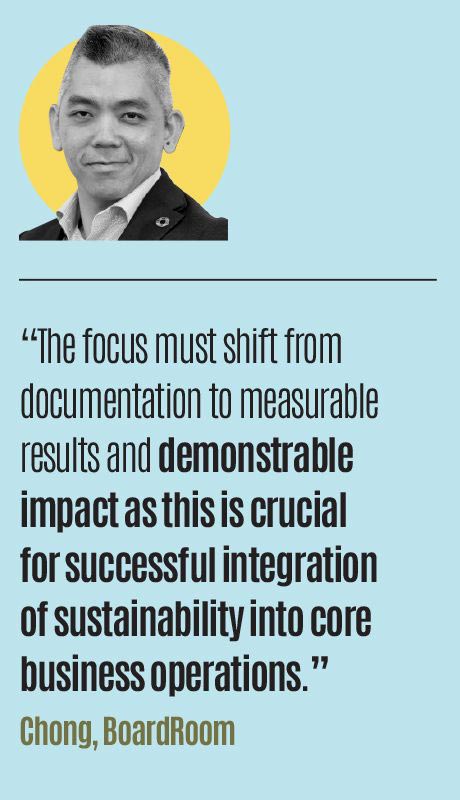
Meanwhile, BoardRoom regional director of sustainability and CEO Action Network lead secretariat Chong Kok Wai wants to see more public listed companies establish concrete baselines for their carbon emissions, develop comprehensive decarbonisation road maps and systematically identify sector-specific sustainability risks and opportunities.
“The focus must shift from documentation to measurable results and demonstrable impact as this is crucial for successful integration of sustainability into core business operations,” he says.
“I would also like to see more in respect of regulation in the SME space and bringing SMEs into the sustainability framework. While this may not be in the form of amendments to the Companies Act, some form of structured regulation or incentive mechanism is essential.”
Mandate human rights due diligence and expand legal aid to foreign workers
The National Action Plan on Business and Human Rights (NAPBHR) 2025-2030 was launched in August by Minister in the Prime Minister’s Department (Law and Institutional Reform) Datuk Seri Azalina Othman Said.
Based on this action plan, the low-hanging fruit that can be implemented include mandating human rights due diligence (HRDD) for companies, says AmerBON Advocates head of chambers (civil) Edmund Bon, who is also lead consultant for the National Baseline Assessment, which was used to develop the NAPBHR.

Another possible initiative is to expand legal aid to foreign workers, says Bon. “I think what is equally important is legal aid for indigenous people and mobile clinics to help out on registration, as a form of protection against statelessness … [the] cabinet just needs to agree to increase the budget for legal aid schemes or legal centres.”
A “high-hanging fruit” to achieve, meanwhile, is the introduction of anti-SLAPP (strategic lawsuit against public participation) laws, which are designed to protect individuals or organisations from lawsuits that are intended to silence or intimidate them for exercising their right to free speech and public participation.
Bon says a lot of research is needed to introduce this new law, to ensure it isn’t misused. This will be spearheaded by the Legal Affairs Division of the Prime Minister’s Department.
“If you have SLAPP suits, it further reduces the avenues for grievances to be raised and addressed. For example, there is a case where workers who came to Malaysia were stranded and when they wanted to lodge a complaint with the labour court, the employer filed an injunction to stop them from making the claims in public or the media on how they had been treated,” says Bon.
“If that is considered a SLAPP suit, then if the court grants the injunction permanently, then no migrant worker would want to come and speak out. They are already in such a vulnerable position.”
Anti-greenwashing laws are something else that should be considered in the long term; to tackle false claims in sustainability reports, for instance.
“But again, that needs a lot of study and buy-in,” says Bon.
It has, however, been challenging to get businesses onboard with these plans, observes Bon. “We should make a lot of these things mandatory, so they can start waking up … We need to get businesses involved.”
This article first appeared in The Edge Malaysia Weekly on September 29, 2025 – October 5, 2025.