By Timothy Achariam and Justin Cheng | The Edge Malaysia
Former prime minister Tan Sri Muhyiddin Yassin’s lawyer has questioned the prosecution’s reliance on TikTok videos as evidence in the corruption trial against the veteran politician.
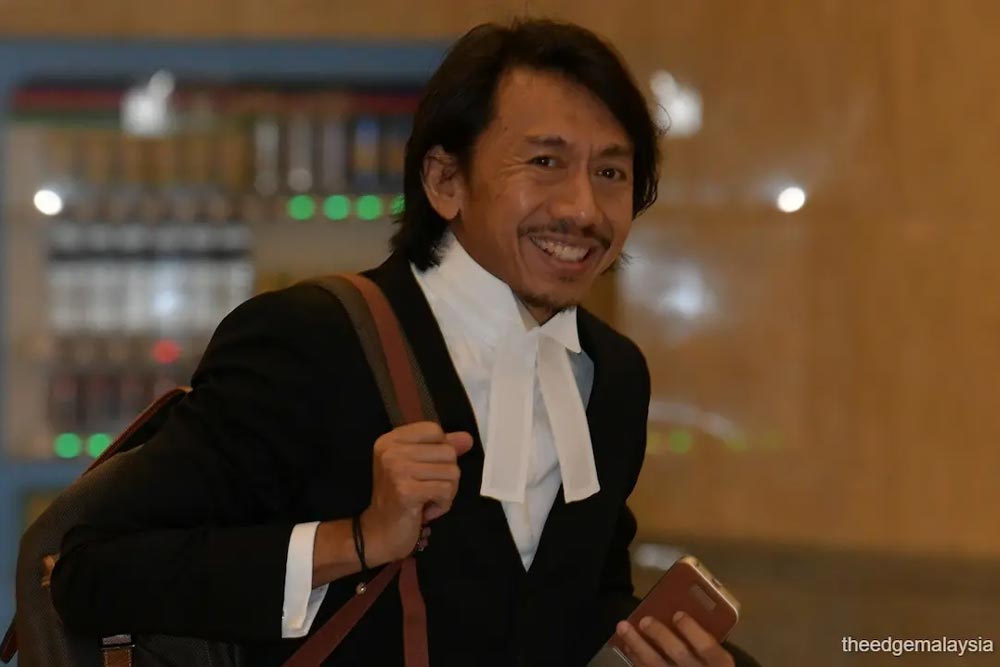
Lawyer Datuk Amer Hamzah Arshad raised the issue with presiding judge Noor Ruwena Nurdin after the prosecution’s first witness, Malaysian Anti-Corruption Commission (MACC) assistant enforcement officer Mohd Syawaludin Said, testified that he had relied on two TikTok videos.
The videos, from two accounts, allegedly showed audio and video evidence of Muhyiddin delivering a speech in which he admitted that monies were deposited into Parti Pribumi Bersatu Malaysia (Bersatu)’s bank account.
During cross-examination, Amer Hamzah argued that edited videos should not be used as evidence.
Amer Hamzah: You said there’s an SOP for investigations for audio and video. You can’t use edited and cut videos (as evidence) but the video is clearly edited, so whose instructions was it that you entered this video for evidence?
Syawaludin: The investigating officer.
Amer Hamzah: You know (MACC Chief Commissioner Tan Sri) Azam Baki has made public statements that video and audio that are edited can’t be used as evidence, are you aware?
Syawaludin: I know.
Amer Hamzah: Azam Baki stated (in news reports) that whatever video that’s edited cannot be used. I suggest to you that all videos are not credible.
Syawaludin: I don’t agree.
Amer Hamzah: That means you are cleverer than the MACC chief?
Judge: I think we [should] just go on with the questioning.
Tensions rose again during deputy public prosecutor Wan Nur Iman Wan Ahmad Afzal’s examination of the witness when Syawaludin used the word “bribe” in describing what Muhyiddin said in the videos.
Amer Hamzah interjected, arguing that the footage did not contain the word.
“Why use TikTok videos as evidence? Is this the standard of our prosecution? Give evidence based on facts. Do not add things that were never said,” the lawyer told the witness.
“The witness should reply to facts rather than interpretations….there is no ‘rasuah’ (bribe) mentioned in the video. This is the witness’s own interpretation,” he added.
Amer Hamzah also asked whether the officer had investigated who had inserted the captions, the geolocation of the video, or its hashtags. Syawaludin replied that he had not.
Syawaludin also confirmed that he had not verified the TikTok accounts that had posted the videos.
However, Syawaludin disagreed with the suggestion that TikTok videos are not credible evidence in court.
Earlier, Amer Hamzah’s co-counsel Datuk Hisyam Teh Poh Teik had objected to the amended charges read to Muhyiddin at the start of the trial.
He said the charges under the MACC Act did not clearly specify how the accused had allegedly used his position.
“The law requires the prosecution to state the particulars of the alleged offence, including whether the accused had made a decision or taken any action, and under what circumstances the offence was said to have been committed.
“The defence has been left ‘in the dark’ as the charges did not explain the steps allegedly taken by Muhyiddin in relation to the decisions cited by the prosecution.”
Hisyam said that the lack of particulars would prejudice the defence and affect Muhyiddin’s right to a fair trial.
Deputy public prosecutor and Deputy Head II of the Appellate and Trial Division at the Attorney General’s Chambers Datuk Wan Shaharuddin Wan Ladin objected, saying that the issue had already been addressed in the Court of Appeal.
“The defence can raise these issues at the end of the prosecution’s case. There is no prejudice as they will still have the right to be heard,” he said.
Ruwena noted that the court had yet to begin hearing evidence and that the prosecution could amend the charges at any time if necessary.
She then directed both parties to proceed with the trial.
At a press conference held by Amer Hamzah after proceedings on Monday, the defence lawyer questioned the reliance of the prosecution on the digital media platform, saying, “The first witness that the prosecution called was an MACC officer….but the evidence that the said officer attended (presented) in court are just recordings or videos that he obtained or downloaded from TikTok accounts.”
He argued that the defence had established through cross-examination that the footage was edited, and concluded that it was a “sad day….when you can’t rely on credible evidence, but instead resort to contents from TikTok”.
Beyond the digital evidence, Hisyam also spoke about his objections to the charges against his client, saying that they are badly drafted with no particulars.
“The (power abuse) charges are bad….no particulars were given compared to the other cases, so we are proceeding with the case at a disadvantage.”
The trial continues on Tuesday.
The charges
Muhyiddin, 78, who was the prime minister and Bersatu president at the material time, was charged with four counts of using his position to obtain bribes totalling RM232.5 million in relation to the Jana Wibawa project from three companies, namely Bukhary Equity Sdn Bhd, Nepturis Sdn Bhd, and Mamfor Sdn Bhd, as well as Datuk Azman Yusoff, for the party.
The offence was allegedly committed at the Prime Minister’s Office, Bangunan Perdana Putra in Putrajaya between March 1, 2020, and Aug 20, 2021.
The Pagoh member of Parliament was charged under Section 23(1) of the Malaysian Anti-Corruption Commission Act 2009, which is punishable under Section 24(1) of the same law.
The section provides for imprisonment for up to 20 years, and a fine of not less than five times the amount or value of the bribe, or RM10,000, whichever is higher, if convicted.
Muhyiddin also faces three counts of receiving proceeds from illegal activities totalling RM200 million from Bukhary Equity, which were deposited into Bersatu’s Ambank and CIMB Bank accounts at the banks’ branches in Petaling Jaya and Kuala Lumpur between February 2021 and July 2022.
The charge was made under Section 4(1)(b) read with Section 87(1) of the Anti-Money Laundering, Anti-Terrorism Financing and Proceeds of Unlawful Activities Act 2001 (AMLA), which is punishable under Section 4(1) of the same Act and carries a penalty of imprisonment for up to 15 years and a fine of not less than five times the amount or value of the proceeds from illegal activities, or RM5 million, whichever is higher, upon conviction.
Edited By Aniza Damis