By Rahmat Khairulrijal | New Straits Times
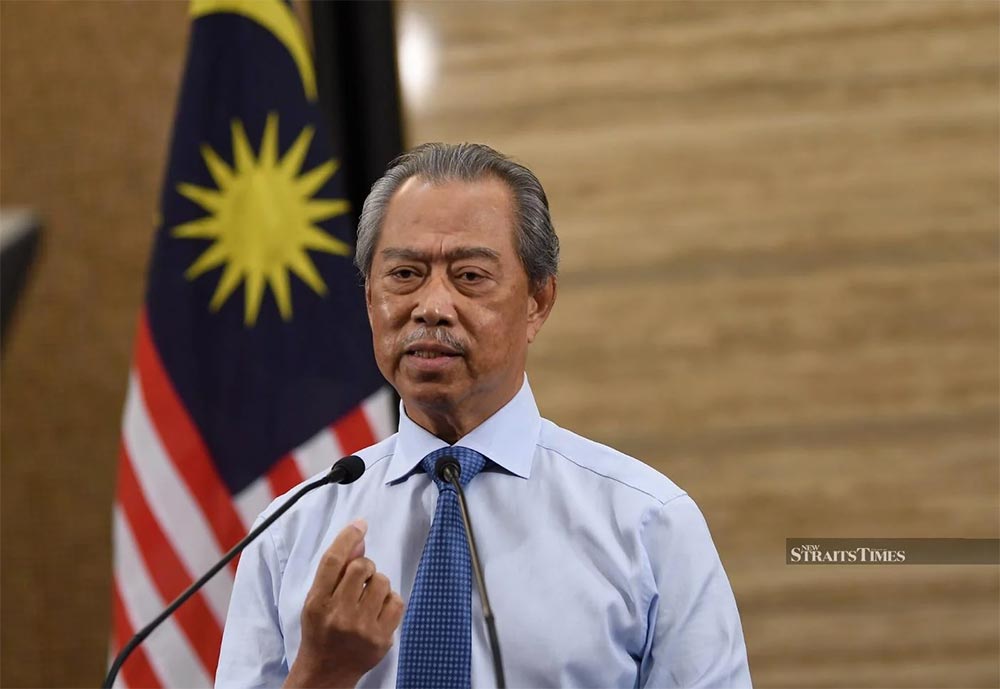
Former prime minister Tan Sri Muhyiddin Yassin’s sedition trial over allegations that he questioned the discretion of the Yang di-Pertuan Agong will proceed to a full trial.
This followed the Federal Court’s decision today to decline answering constitutional questions posed by the Parti Pribumi Bersatu Malaysia president, ruling that the issues could be dealt with during the trial.
A five-member Federal Court bench, chaired by Court of Appeal Datuk Seri Abu Bakar Jais, then ordered the case to be remitted to the Kuala Lumpur High Court.
Earlier, Muhyiddin’s counsel, Datuk Amer Hamzah Arshad, told the bench that both parties had agreed for the issues to be deliberated during the trial at the lower court.
Meanwhile, Abu Bakar said the action of referring the questions to the Federal Court amounted to a waste, as any decision by the apex court would be binding on the applicant (Muhyiddin) if it was not in his favour.
According to Abu Bakar, if the Federal Court were to proceed to hear and determine the legal questions, there would be no remaining avenue of appeal should any party be dissatisfied with the Federal Court’s decision.
He said that if the questions were heard at the High Court, the applicant (Muhyiddin) would still have the opportunity to appeal to the Court of Appeal and the Federal Court.
“The question is, which is better for the accused? At this stage, should the High Court be bound by what has been decided by the Federal Court?
“(Or) is it better for the accused to allow the High Court, without being bound by the Federal Court, to determine the questions?
“Therefore, in view of what has been stated by counsel and the deputy public prosecutors, this court will not answer the questions raised at this stage.
“As such, the case currently before us is remitted to the High Court to be tried. At this stage, the trial has not commenced and witnesses have not been called,” he said.
Also sitting were Chief Judge of Malaya Datuk Seri Hashim Hamzah and Federal Court judges Datuk Rhodzariah Bujang, Datuk Lee Swee Seng and Datuk Mohd Nazlan Mohd Ghazali.
Among the questions raised was whether Section 4 of the Sedition Act 1948 read together with Section 3(3) of the same Act amounts to an unreasonable restriction and is contrary to Article 10(1)(a) of the Federal Constitution, and whether Section 3(2) of the same Act read together with Section 3(3) is unconstitutional as it contravenes the accused’s right to a fair trial.
On April 4, last year, the 78-year-old filed an application to refer a question of law concerning the Sedition Act, challenging the validity of certain provisions of the legislation.
He had previously pleaded not guilty to a charge of making seditious remarks while campaigning during the Nenggiri state by-election at Dewan Semai Bakti Felda Perasu, between 10.30pm and 11.50pm on Aug 14, last year.
The alleged remarks involved his claim that he was not invited by the Yang di-Pertuan Agong to be sworn in as prime minister following the 15th General Election, despite reportedly having the support of 115 out of 222 members of parliament at the time.
Muhyiddin is charged under Section 4(1)(b) of the Sedition Act 1948, which carries a maximum fine of RM5,000, a maximum imprisonment of three years, or both if convicted.